

The best partners pages do three jobs at once: prove an ecosystem exists, help a visitor find the one partner or integration they came for, and quietly recruit the next partner. The 42 examples below show how real SaaS companies pull it off, from app marketplaces with thousands of listings (Shopify, Atlassian, Salesforce) to focused directories of a few dozen agencies.
Every page here was visited and screenshotted in August 2026. Each entry has a short teardown of what that page actually does well, the details worth copying, and a link to the live version so you can judge it yourself.
Two patterns stood out while cataloguing them. First, almost every directory here gives each partner its own URL, a real page that can rank on its own rather than a modal or a bare outbound link. Second, 14 of the 42 run on PartnerPage, a hosted tool starting around $500/month, and several of those serve their directory from a *.partnerpage.io subdomain rather than their own domain, which hands the SEO value to someone else’s root domain.
App and integration marketplaces
These directories list software: apps, connectors and integrations that plug into the host product. They are the largest pages in the roundup, and the ones that lean hardest on search, categories and ratings.
1. Airtable Integrations
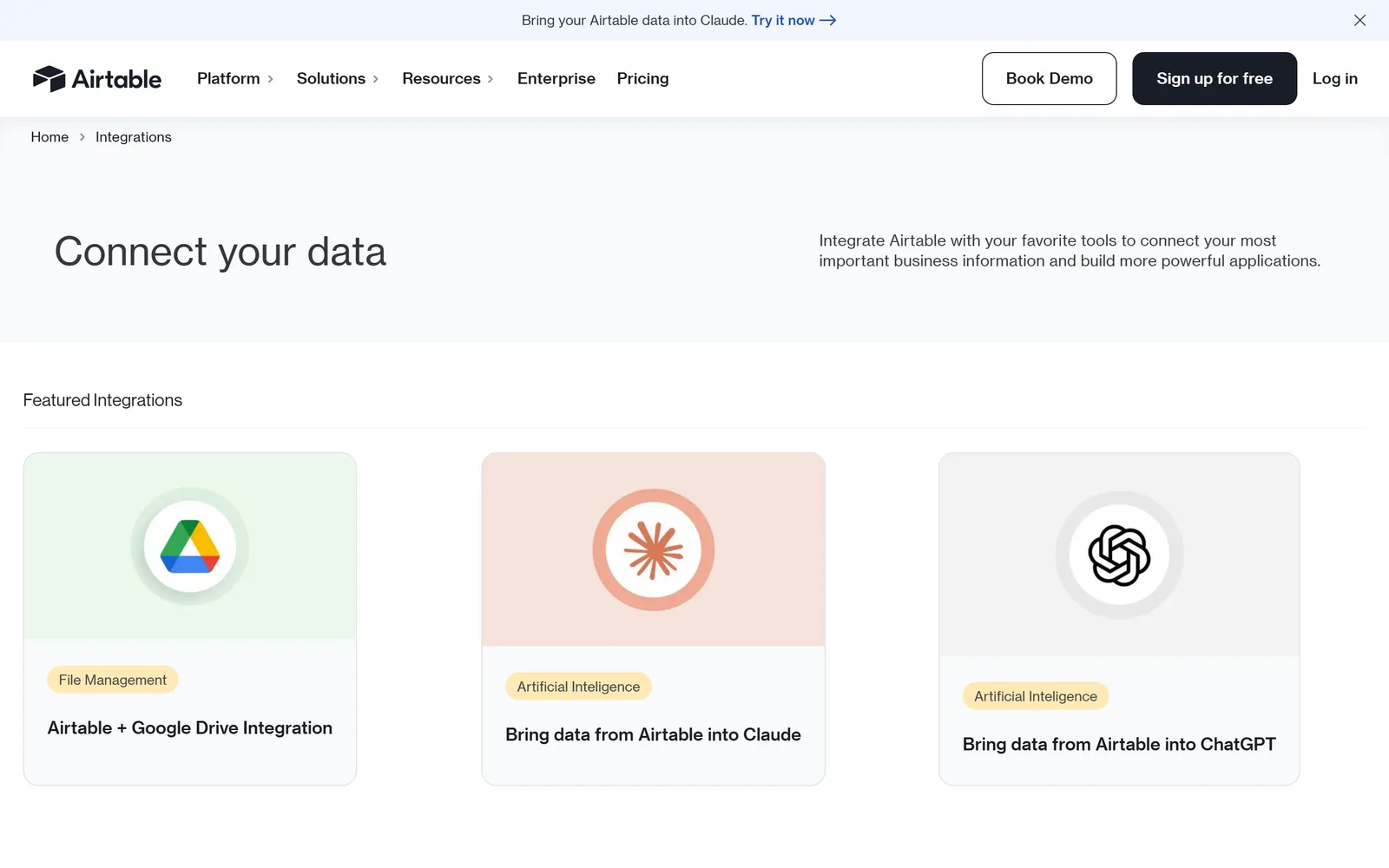
Airtable’s integrations page is the discovery layer for its tech partners: a card grid grouped by category, spanning facets from File Management and AI to CRM and Payments, with a Featured Integrations section pinned on top. Every card carries a logo, name, and category label, and clicks through to a dedicated detail page at /integrations/<service-name>.
Consistent card metadata plus a featured row is enough structure, even without search or badges.
Layout: Grid · Lists: Tech partners · Industry: Productivity & collaboration · Built with: First-party · Visit the live page
2. Apideck Integrations
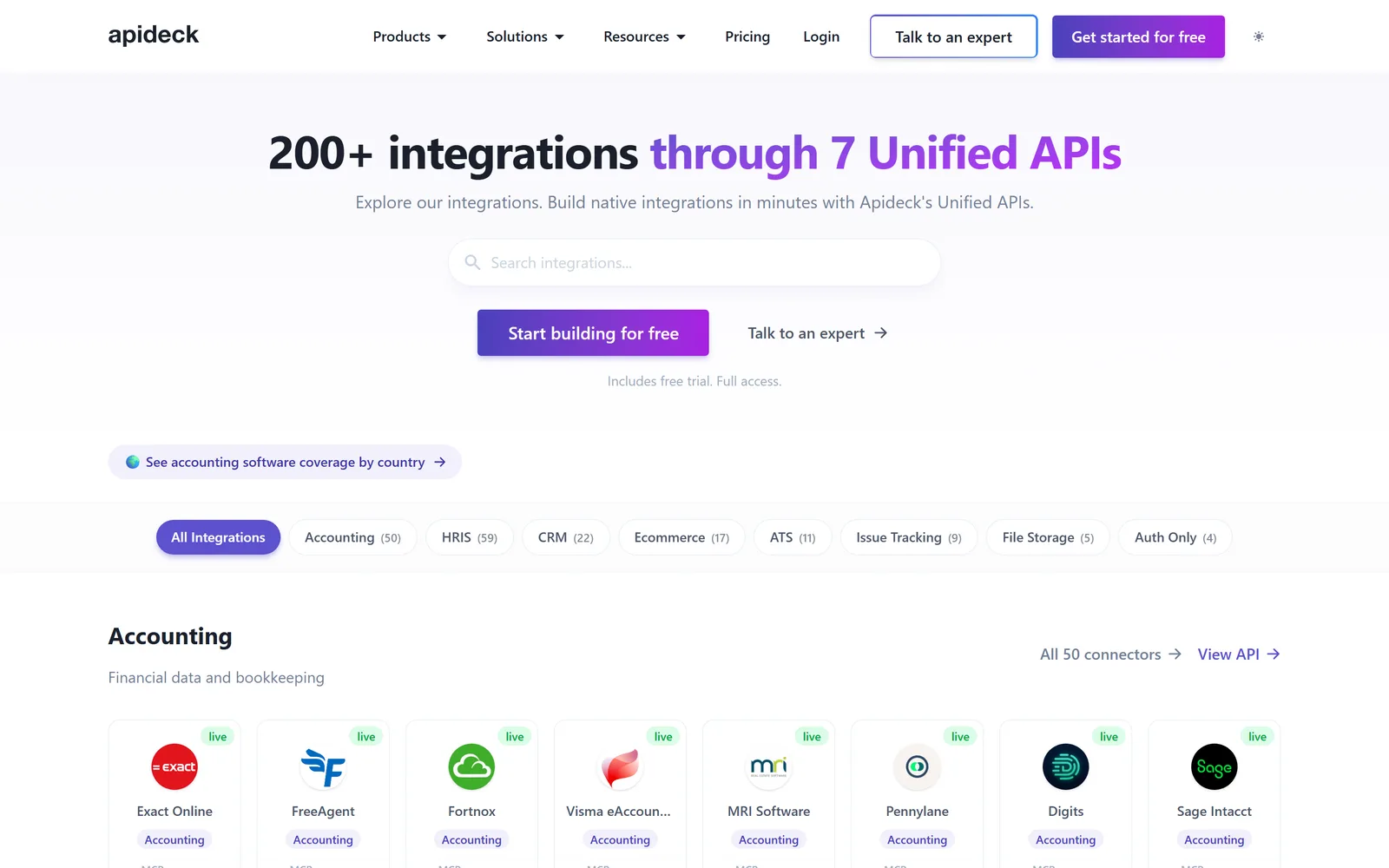
Category tabs organize Apideck’s 200+ integrations by unified API, each tab showing its exact connector count (Accounting 50, HRIS 59, CRM 22), with every listing linking to its own detail page. Each connector also carries a live or upcoming status badge, turning the directory into a public roadmap.
Showing what’s coming, not just what’s shipped, makes a directory a sales tool.
Layout: List · Lists: Tech partners · Industry: Developer tools & APIs · Built with: First-party · Visit the live page
3. Apollo.io Integrations Directory
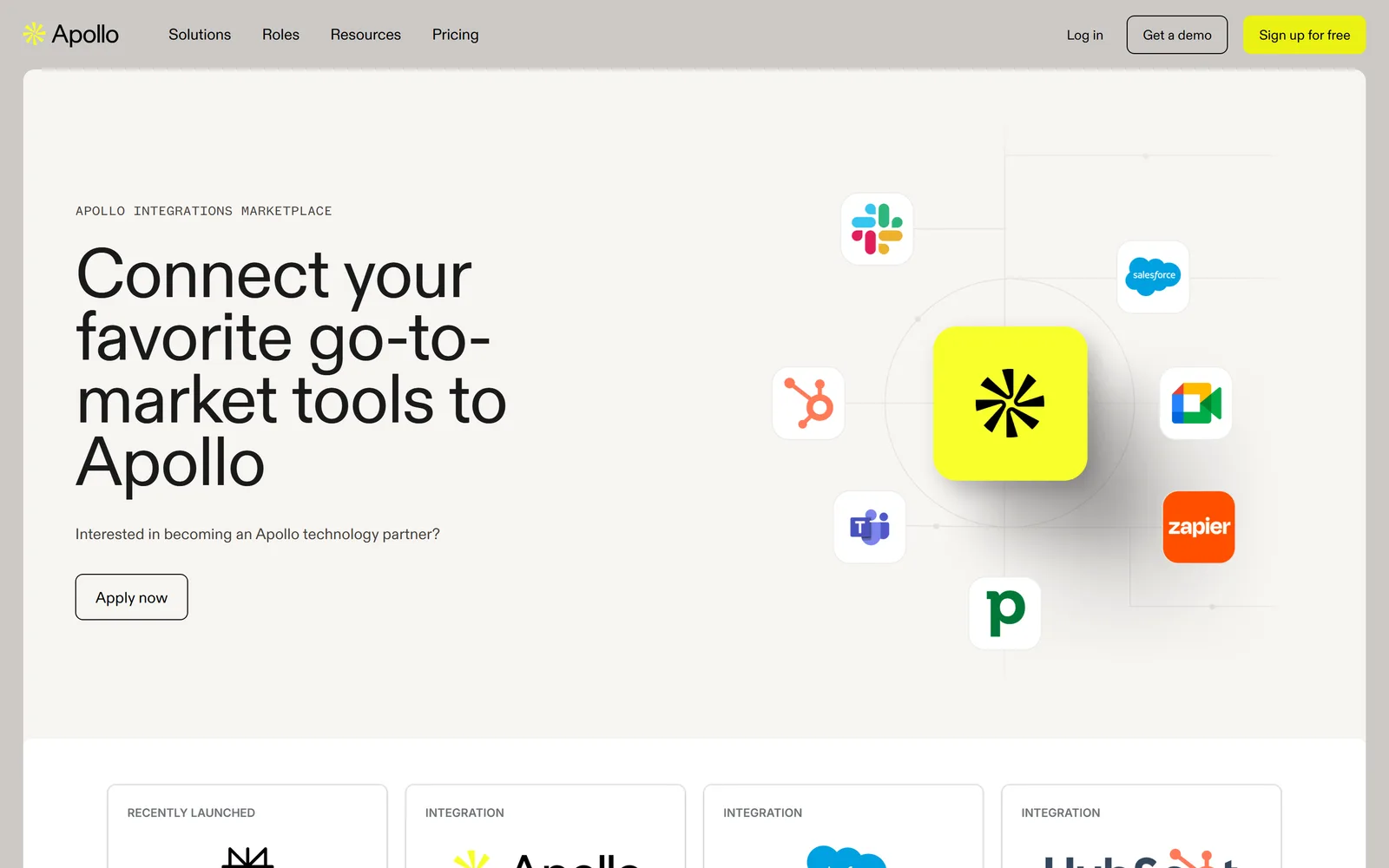
Apollo.io lays out 40+ listings in a grid faceted by Collections and Categories like CRM, Dialer, and Waterfall Enrichment, with a “Recently Launched” section giving new integrations a spotlight. The Collections split is the clever part: “Built by Apollo” versus “Built by Partner.”
It runs on PartnerPage rather than a custom build, and a become-a-technology-partner CTA turns browsers into applicants.
Layout: Grid · Lists: Tech partners, Marketplace apps · Industry: Sales · Built with: PartnerPage · Visit the live page
4. Atlassian Marketplace
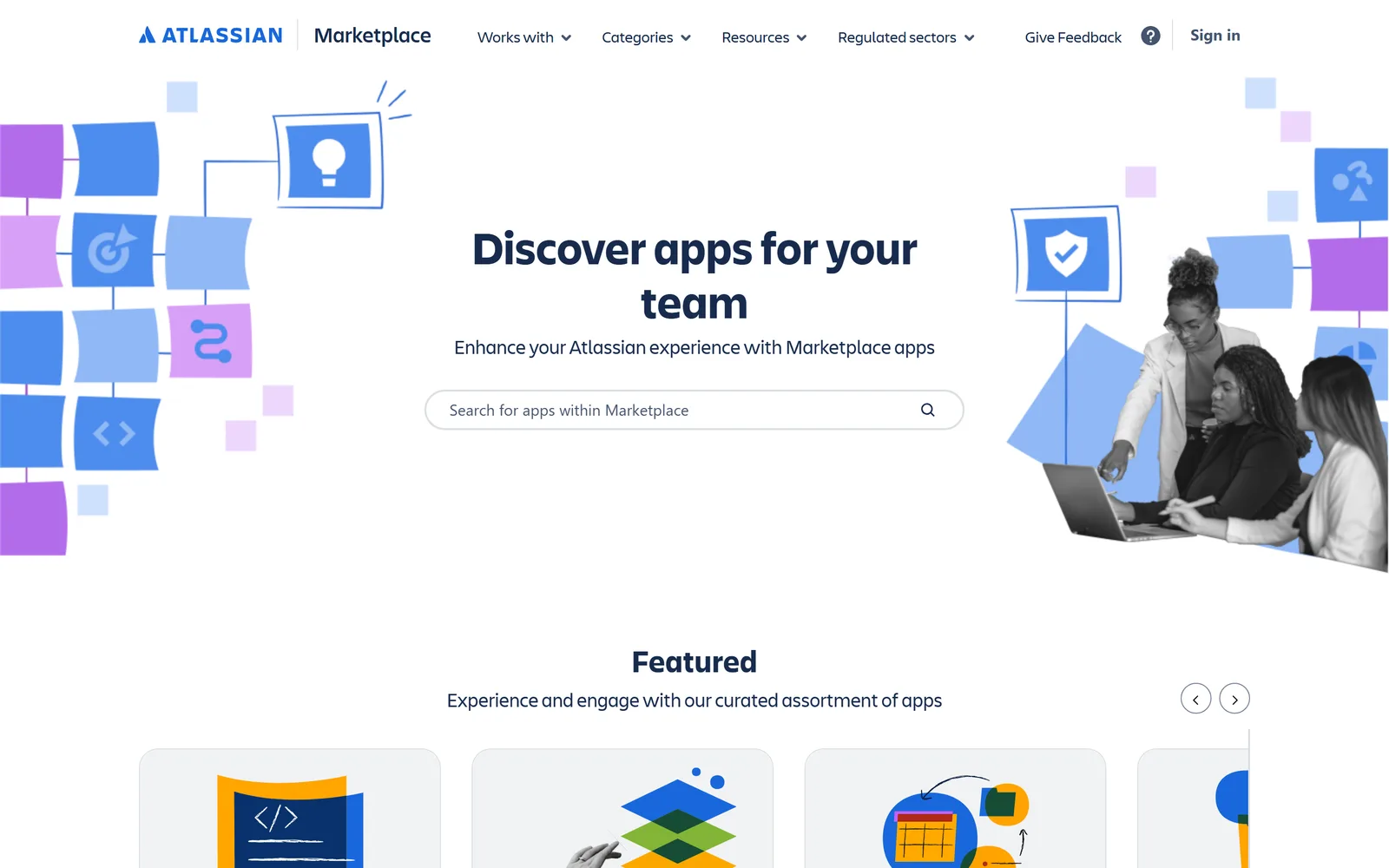
7,000+ apps are organized by nine featured categories plus curated collections like Spotlight, Bestsellers, and Rising Stars. Every listing card carries proof up front: a star rating, review count, install count, and Platinum/Gold/Silver partner tier badge.
Trust signals double as navigation here: designations like Cloud Fortified and Runs on Atlassian become browsable collections in their own right.
Layout: Searchable directory · Lists: Marketplace apps, Tech partners · Industry: Productivity & collaboration · Built with: First-party · Visit the live page
5. BigCommerce App Marketplace
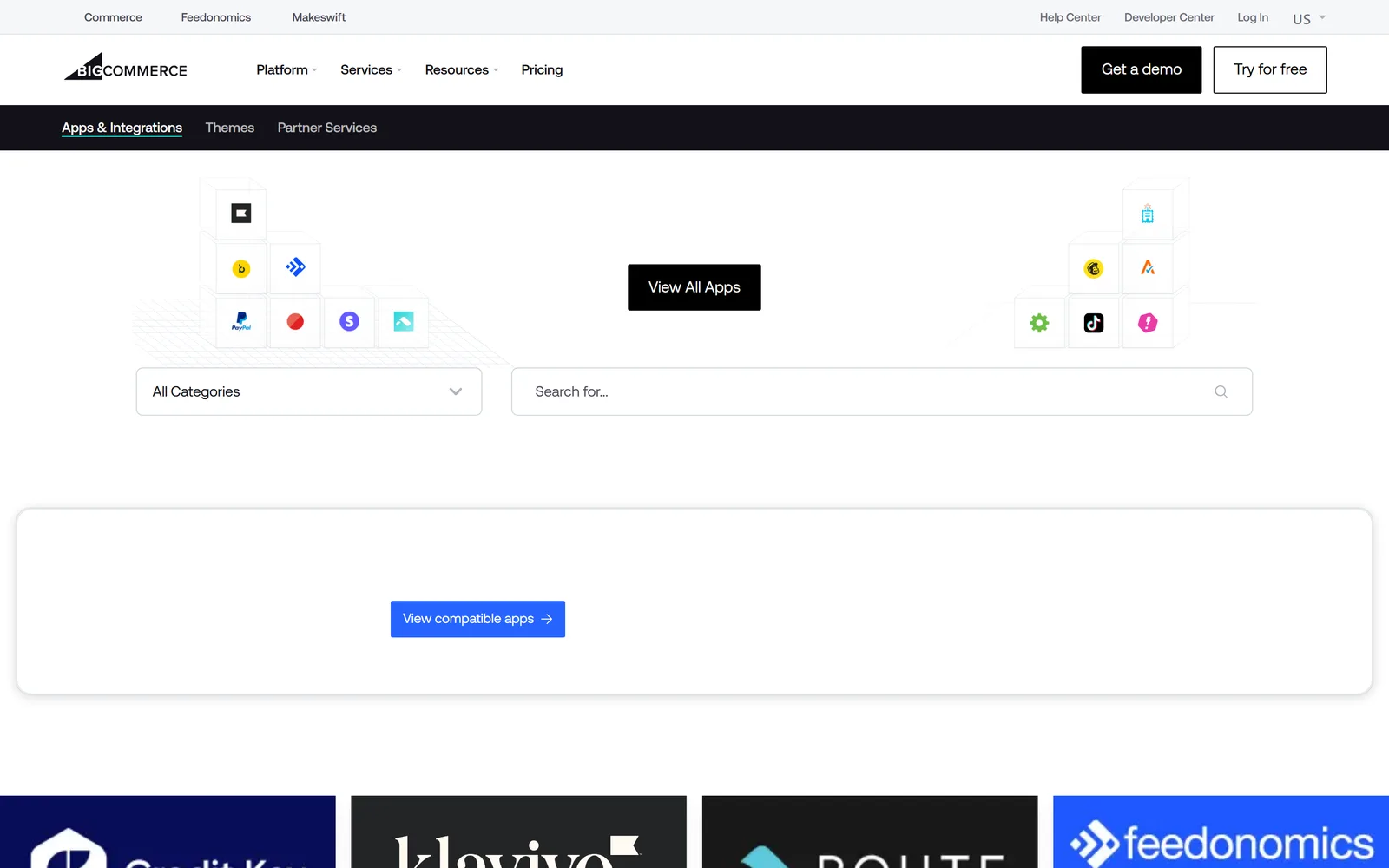
The filter sidebar treats partner status as a first-class facet: 1,200+ apps can be narrowed by Partner Tiers, price, star rating, and platform-specific compatibility flags like Catalyst and Multi Storefront. The two-level category taxonomy gets dedicated crawlable URLs, turning each category into its own landing page.
Those category pages double as marketing real estate, embedding report and blog cards alongside listings.
Layout: Searchable directory · Lists: Marketplace apps, Tech partners · Industry: E-commerce · Built with: First-party · Visit the live page
6. Calendly Integrations Directory
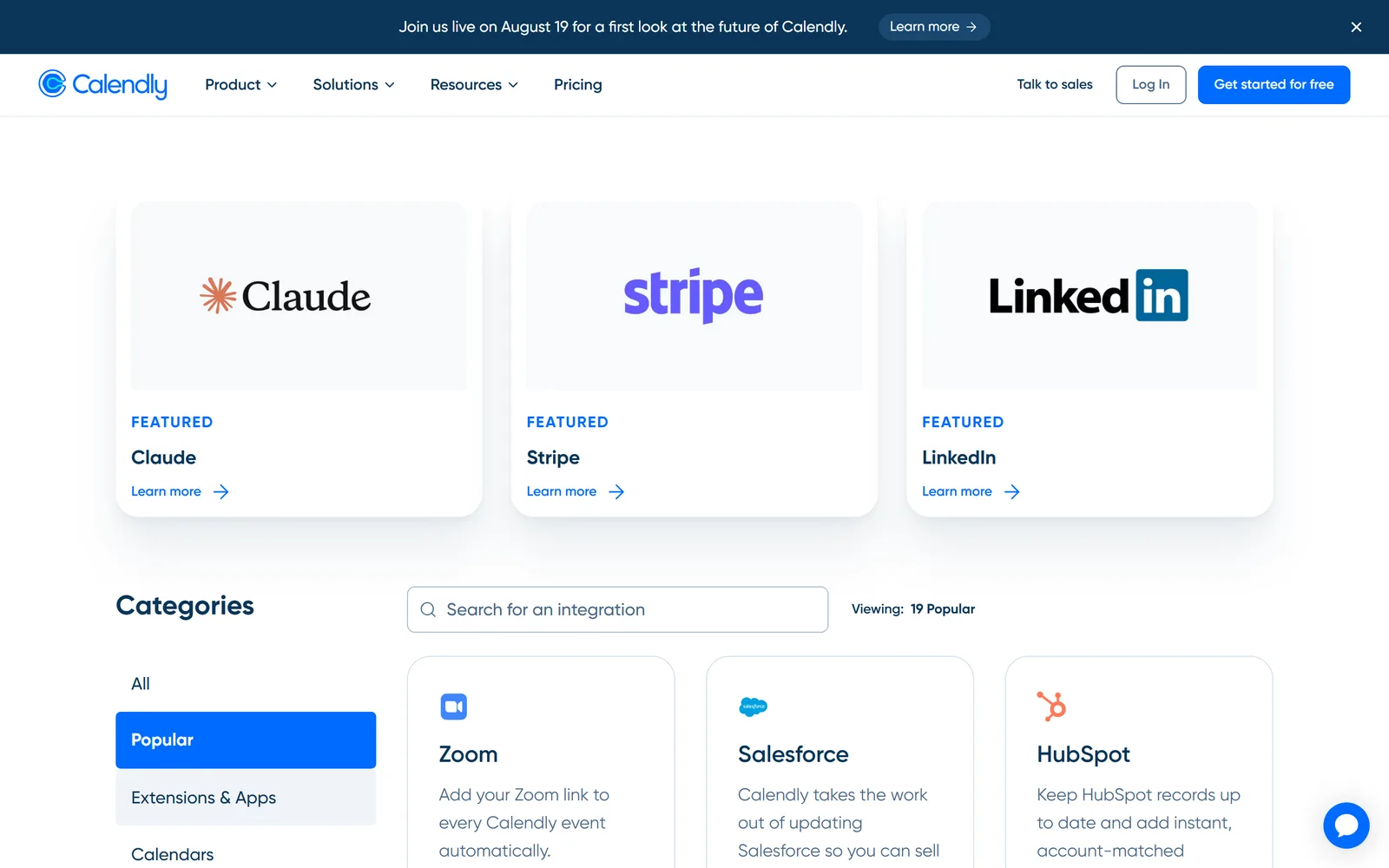
Seventeen category tabs organize Calendly’s integration directory, spanning AI-era facets like AI Assistants and Embed Calendly alongside a search bar and a Featured spotlight row currently promoting Claude, Stripe, and LinkedIn. Every listing links to its own detail page at /integration/<name>.
The distinctive touch: instead of a become-a-partner form, a “Build With Us” CTA sends prospective partners straight to the API docs.
Layout: Searchable directory · Lists: Tech partners, Marketplace apps · Industry: Scheduling · Built with: First-party · Visit the live page
7. Celigo Integrations
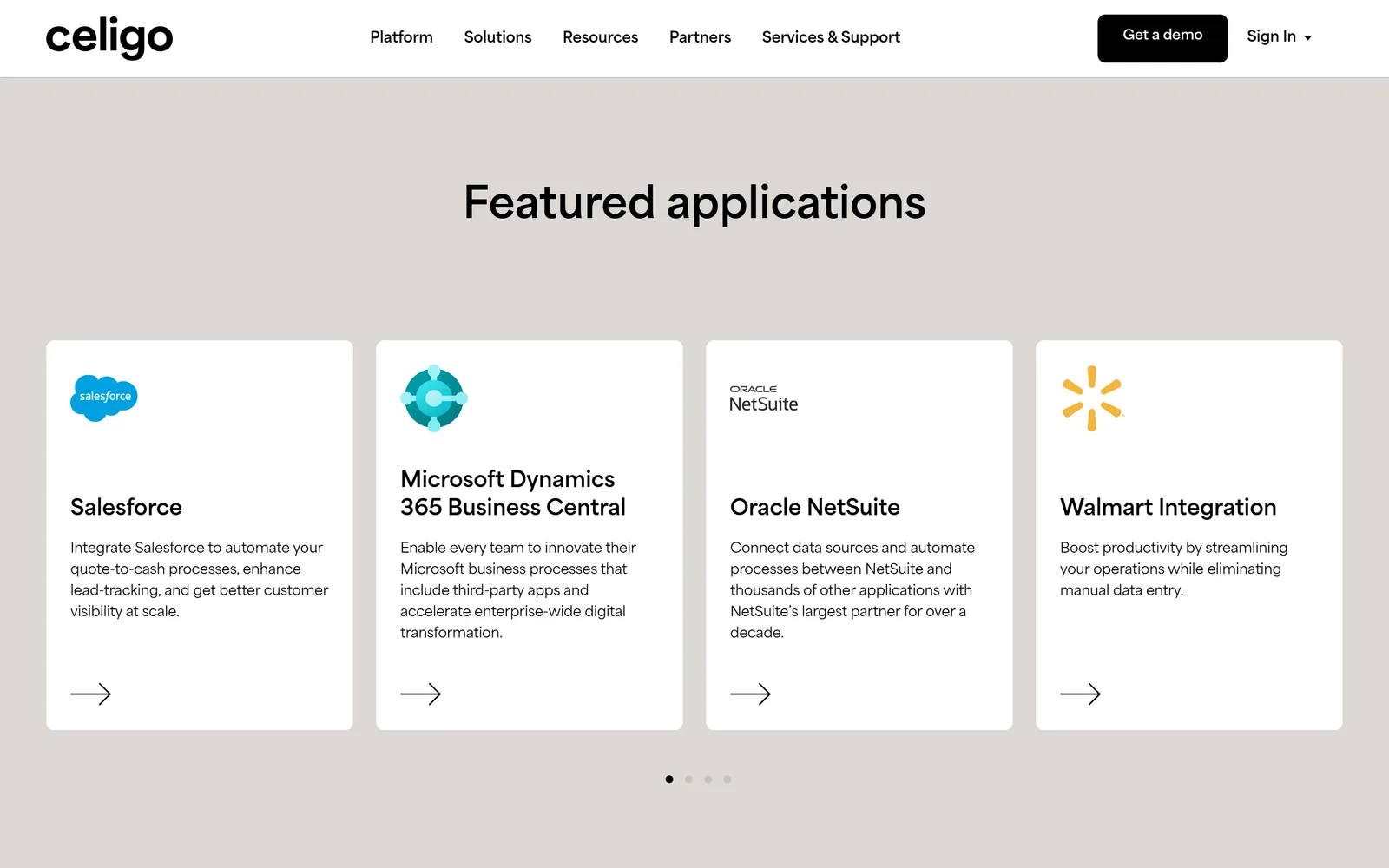
Celigo organizes 300+ integrations as a featured-applications wall of eight big names (Snowflake, Salesforce, Stripe) above a flat A-Z searchable list, with each app linking to its own /integrations/ detail page.
A “Don’t see your app? No problem” section converts dead-end searches into a pitch for universal HTTP, FTP, and GraphQL connectors, turning a missing listing into a sales conversation instead of a bounce.
Layout: Searchable directory · Lists: Tech partners, Marketplace apps · Industry: Developer tools & APIs · Built with: First-party · Visit the live page
8. Cin7 Integrations Directory
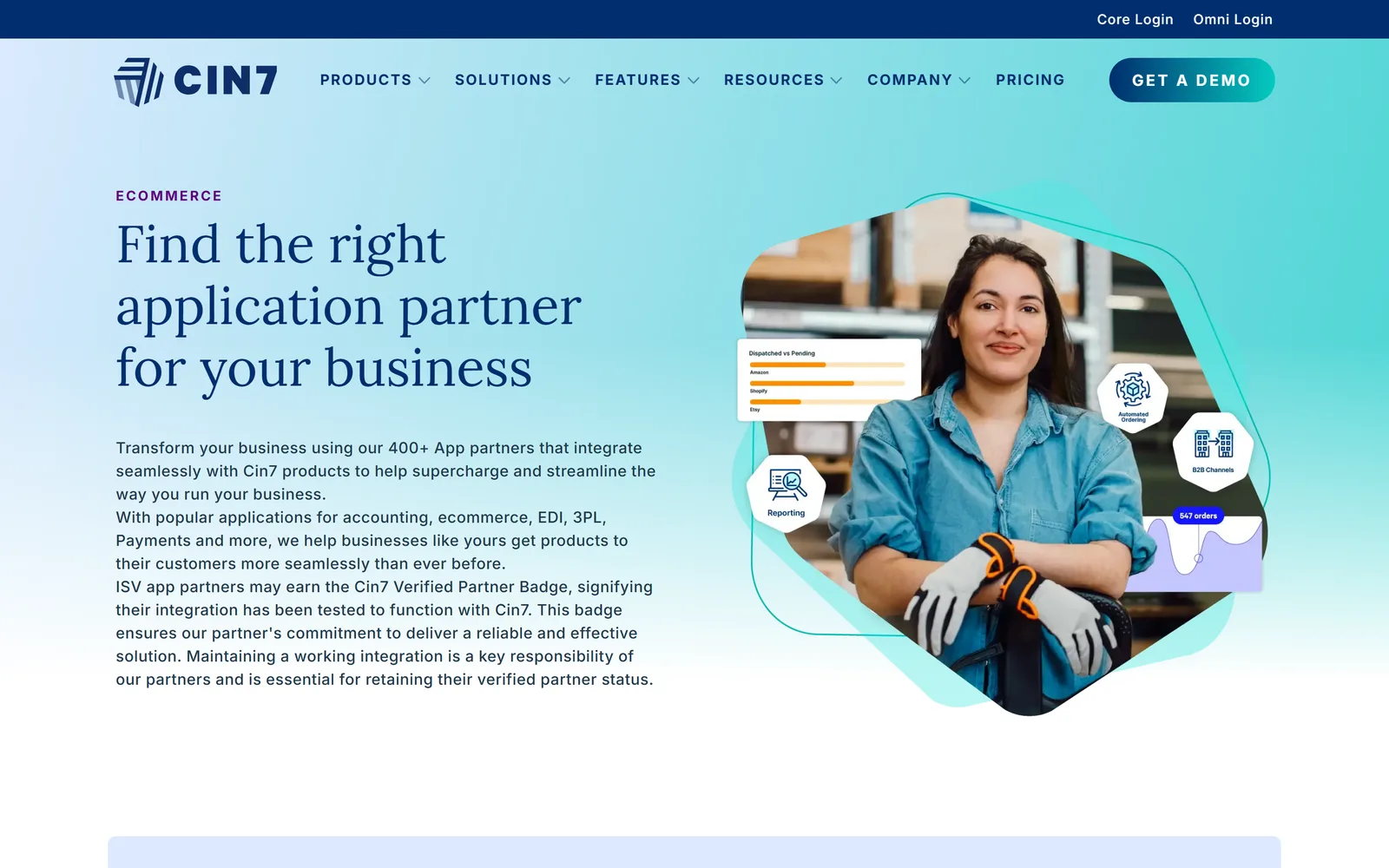
400+ app partners sit in a searchable directory, filterable by 15 functional categories plus product-line collections for Cin7 Core, Omni, and Native. A “Verified Partner” badge marks integrations tested to work with Cin7, and every card carries a Contact CTA.
Splitting filters by product line is the part worth copying: buyers only see integrations that fit the edition they bought.
Layout: Searchable directory · Lists: Tech partners, Marketplace apps · Industry: Inventory & operations · Built with: PartnerPage · Visit the live page
9. Clover App Market
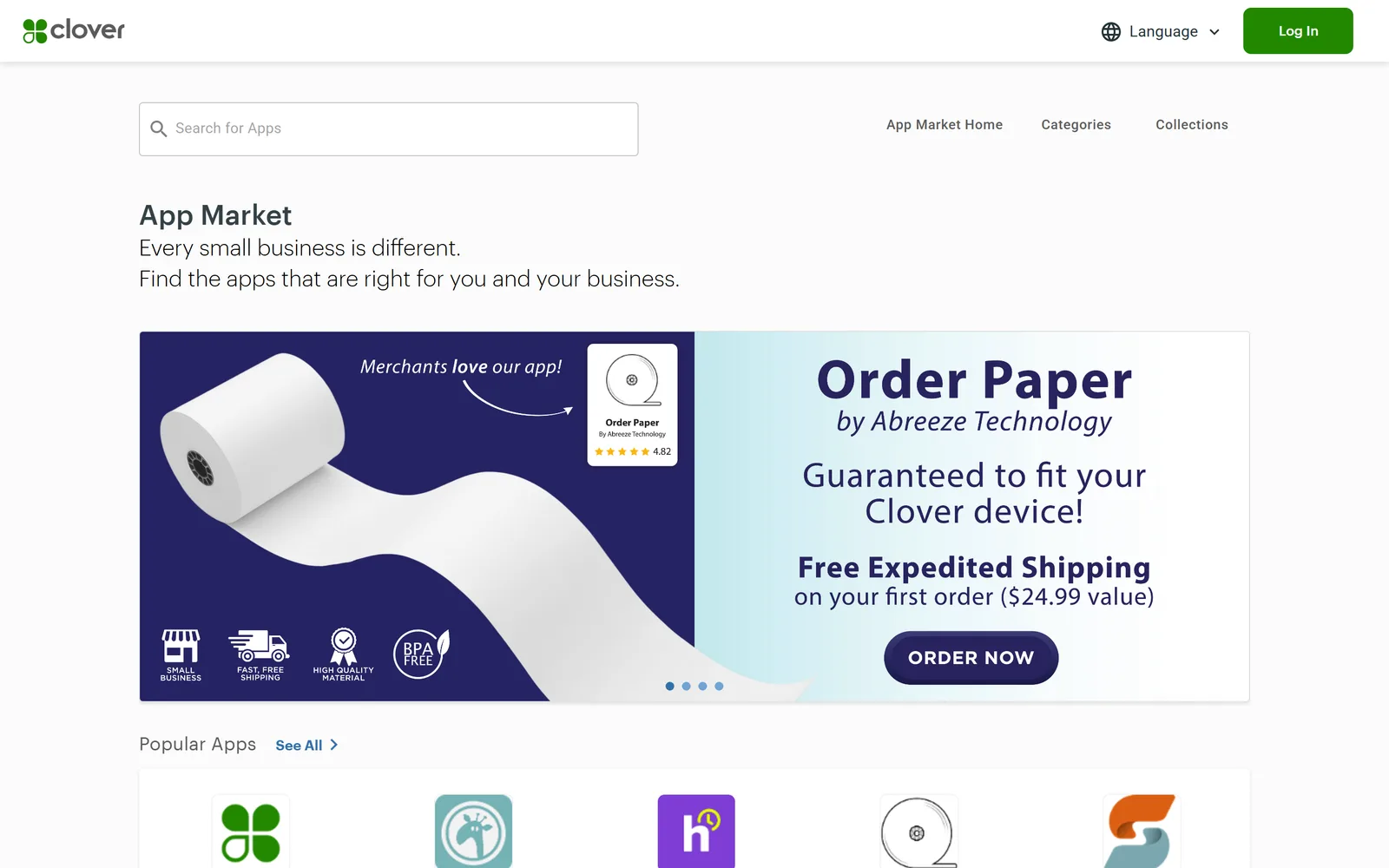
Clover’s App Market lists hundreds of point-of-sale apps, browsable by Categories and curated Collections like Popular Apps, New & Notable, and Top Paid Apps, each sortable by Top Rated, Most Popular, or Newest. The merchandising is unusually detailed: cards carry star ratings to two decimals plus badges like “Free plan available” and “Subscription Pricing”.
If you monetize integrations, copy the pricing badge; it answers the buyer’s first question before a click.
Layout: Searchable directory · Lists: Marketplace apps, Tech partners · Industry: Payments & fintech · Built with: First-party · Visit the live page
10. Gusto App Directory
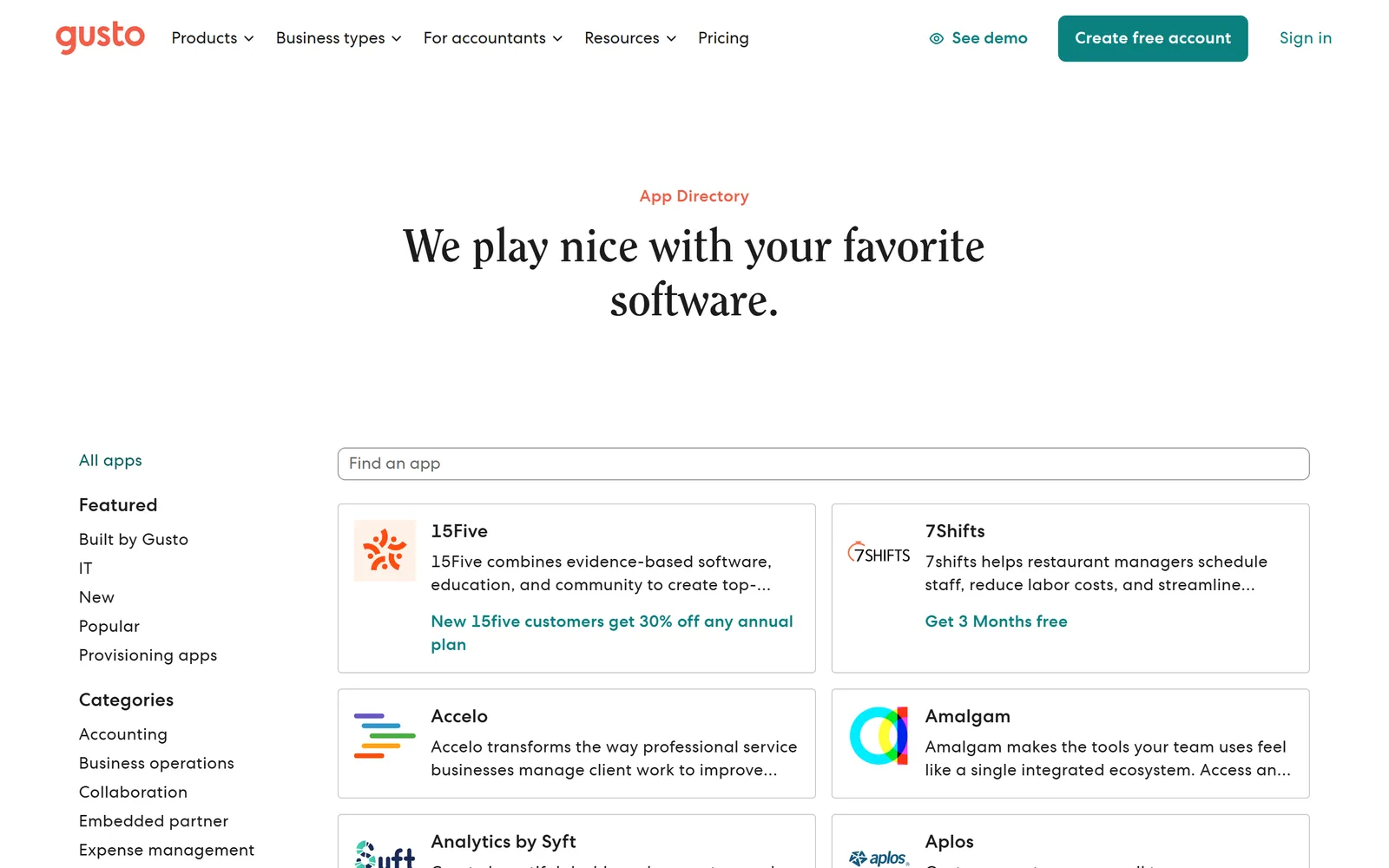
151 apps sit in Gusto’s App Directory, a searchable, paginated list filterable by a single Category facet whose ~17 options mix real categories (Accounting, Time tracking) with curated labels like Built by Gusto, New, and Popular. Many cards also carry partner promo offers as badges, such as “7shifts: Get 3 Months free.”
Turning co-marketing deals into visible card badges gives visitors a reason to click beyond feature fit.
Layout: Searchable directory · Lists: Tech partners, Marketplace apps · Industry: HR & payroll · Built with: First-party · Visit the live page
11. HubSpot App Marketplace
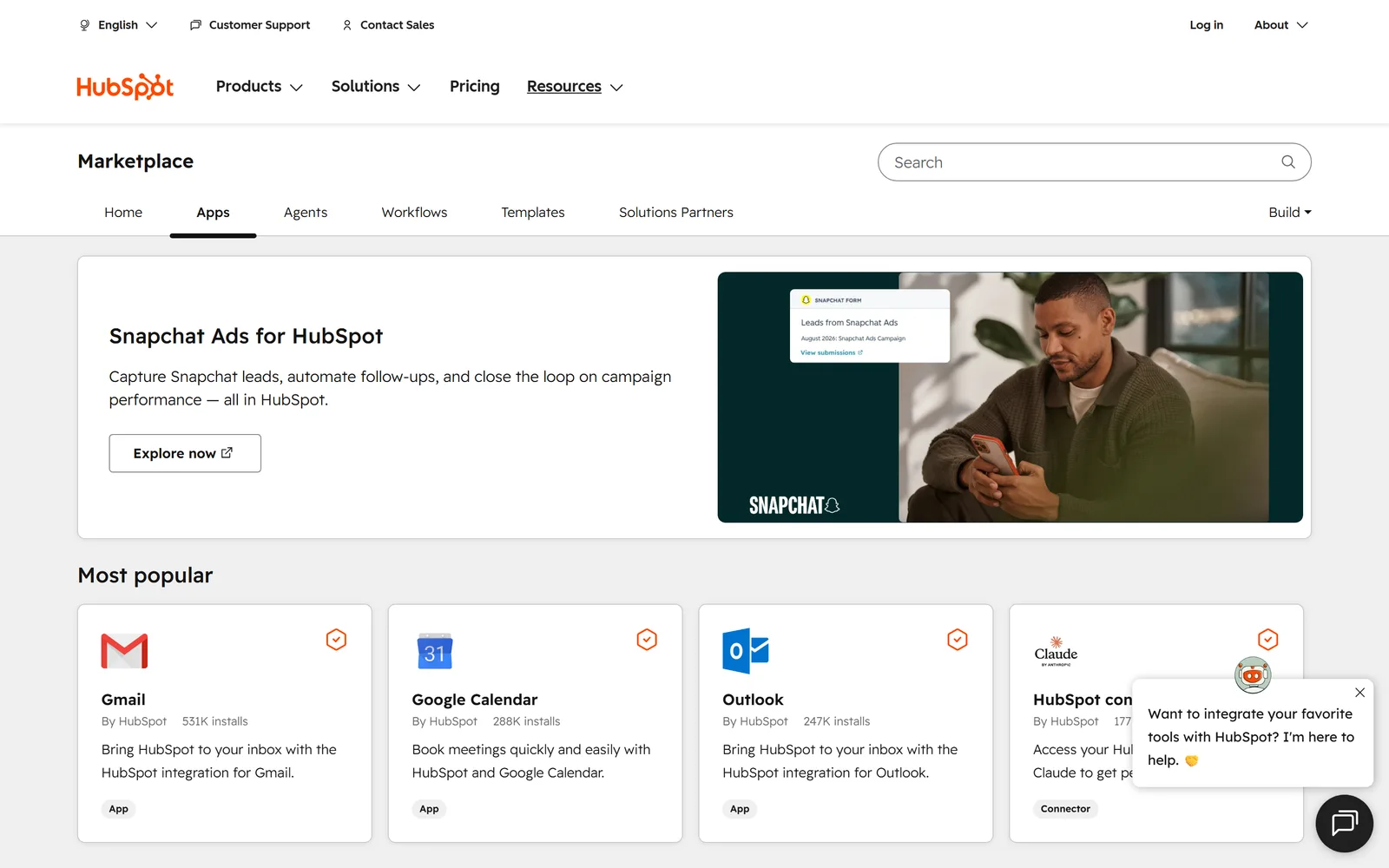
HubSpot organizes its App Marketplace like a storefront: curated rows such as “Most popular,” “New arrivals,” and “Getting attention today” sit under five tabs covering Apps, Agents, Workflows, Templates, and Solutions Partners. Social proof runs at the card level, with install counts from 10+ up to 532K.
Giving agencies (Solutions Partners) their own tab beside the apps lets one directory serve both partner types.
Layout: Searchable directory · Lists: Tech partners, Marketplace apps, Agencies · Industry: Marketing & CRM · Built with: First-party · Visit the live page
12. Intercom App Store
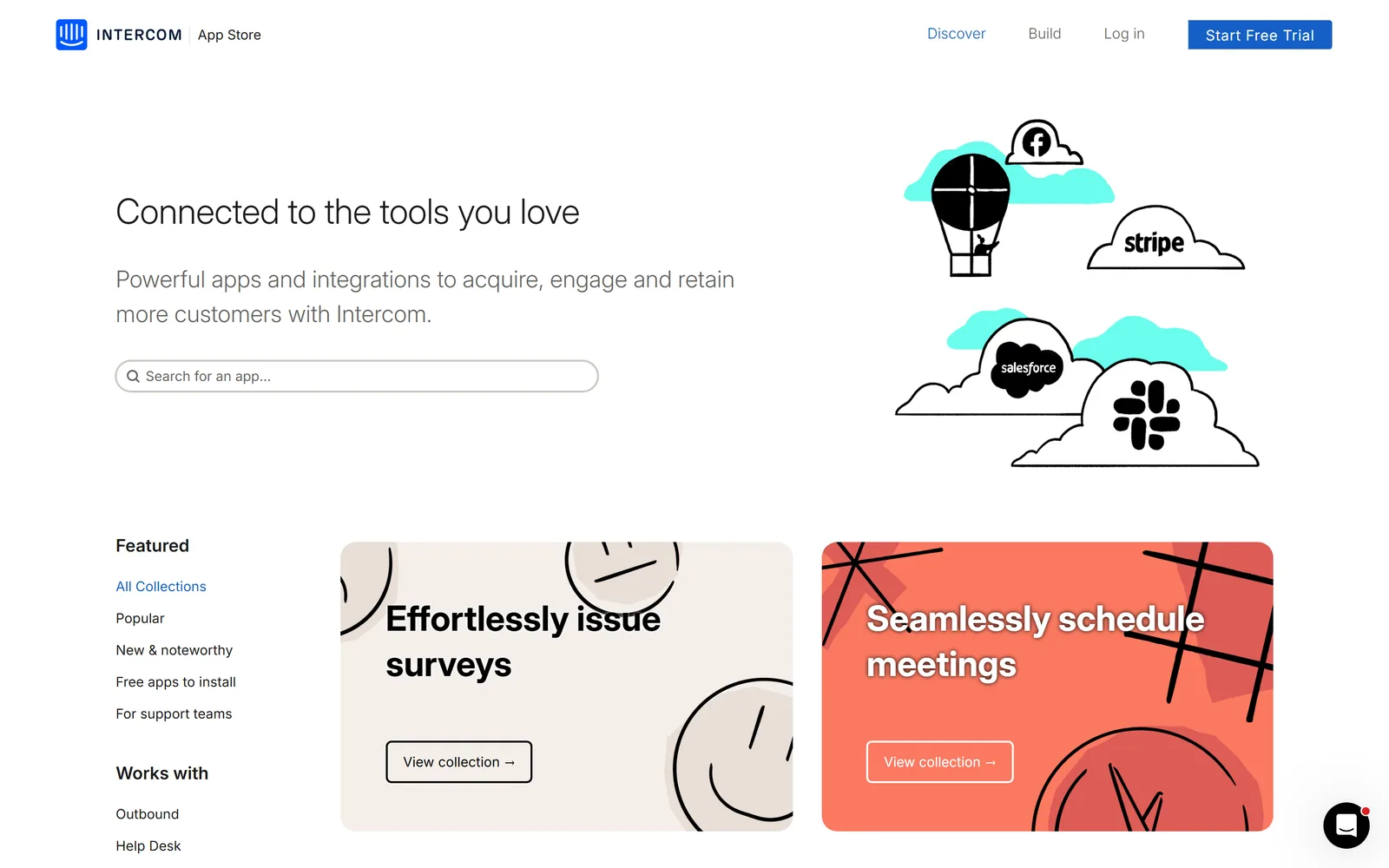
The App Store opens on curated collections (Popular, New & noteworthy, Free apps to install) backed by 18 category facets and a “Works with” filter that maps apps to Intercom’s own products. Cards stay minimal: logo, name, and a one-line description, with no ratings or install counts.
Pairing editorial collections with a product-capability facet answers “what works with the tool I use” faster than categories alone.
Layout: Searchable directory · Lists: Tech partners, Marketplace apps · Industry: Customer support · Built with: First-party · Visit the live page
13. Klaviyo Marketplace
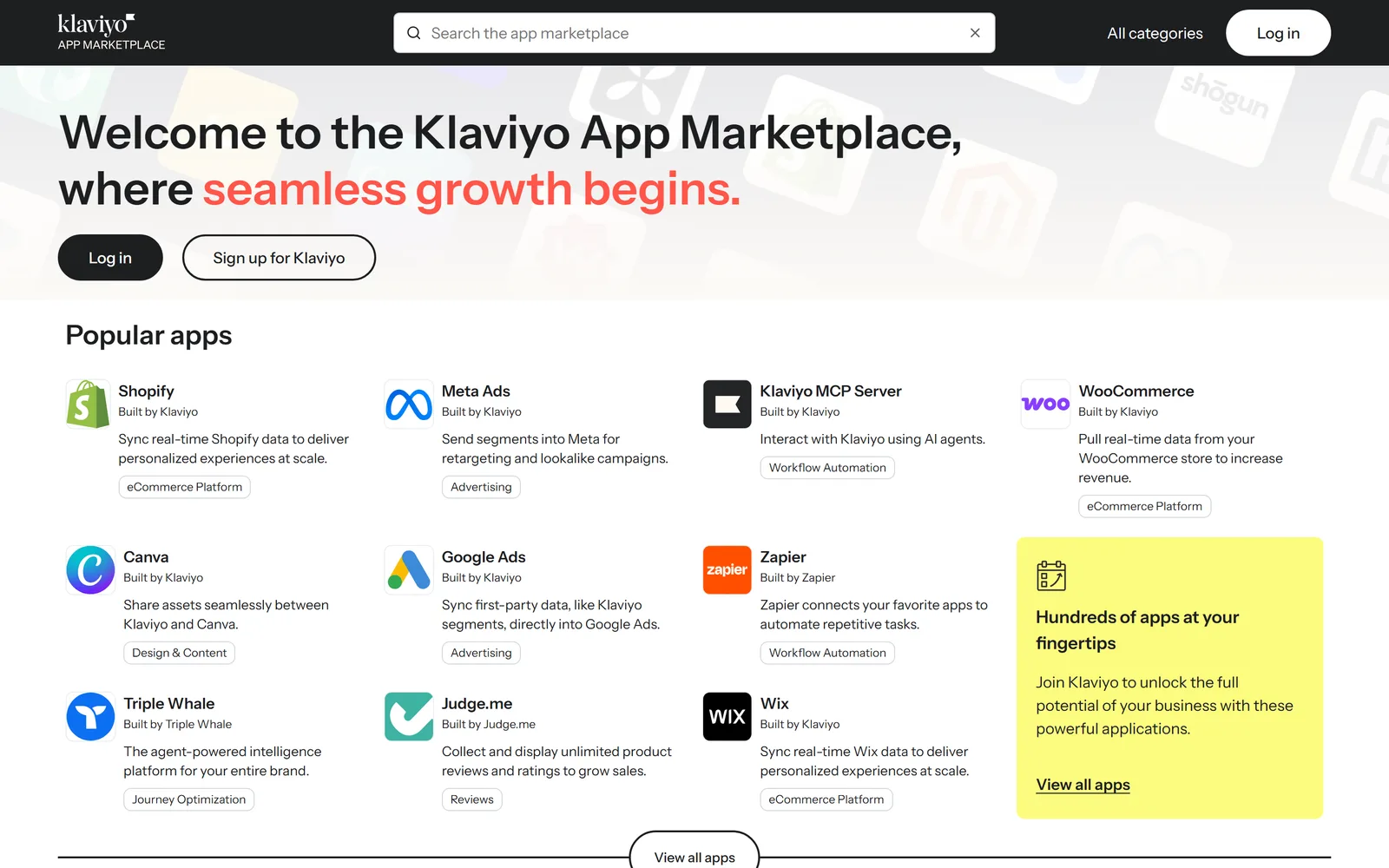
Search across 350+ apps or browse by category, with featured cards up top and a “View all apps” link into the full grid. Klaviyo gives the whole thing a dedicated subdomain, marketplace.klaviyo.com, and each card carries a banner image, icon, developer name, and one-line tagline before clicking through.
Treating the directory as its own product, rather than a page buried under /partners, signals how seriously the ecosystem is run.
Layout: Searchable directory · Lists: Tech partners, Marketplace apps · Industry: Marketing & CRM · Built with: First-party · Visit the live page
14. Loop Returns Integrations
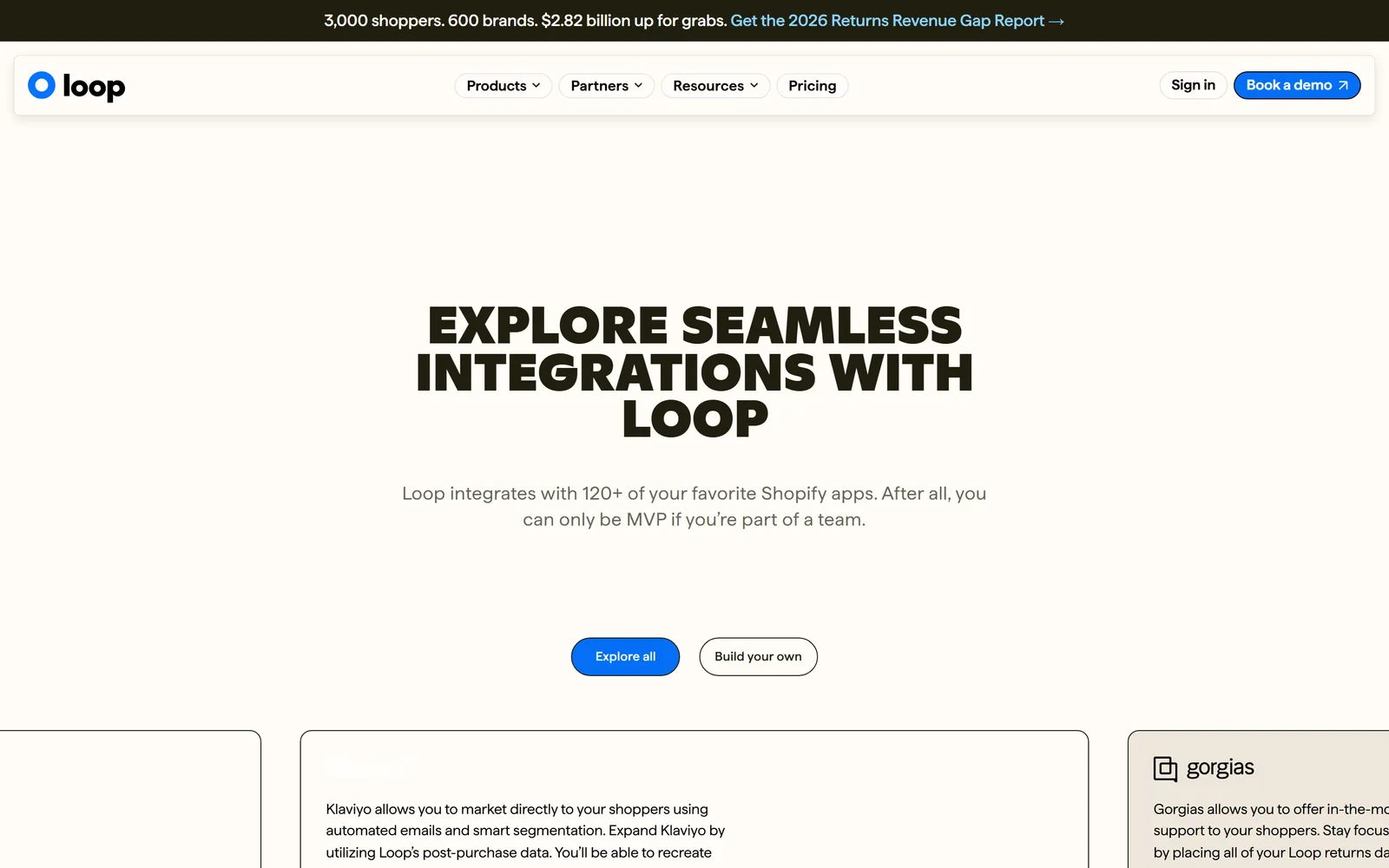
Loop’s Integrations page claims 120+ Shopify apps, curated into three category sections (Customer Experience, Logistics, Shipping) fronted by featured partners like Klaviyo, Gorgias, and ShipBob, with the full catalog living on a PartnerPage-hosted subdomain. Each card pairs a logo with a short partnership-value blurb and visual preview.
It’s a hand-curated marketing layer over a hosted directory, plus a “Build your own” API CTA for anything not listed.
Layout: Grid · Lists: Tech partners, Marketplace apps · Industry: E-commerce · Built with: PartnerPage · Visit the live page
15. Miro Marketplace
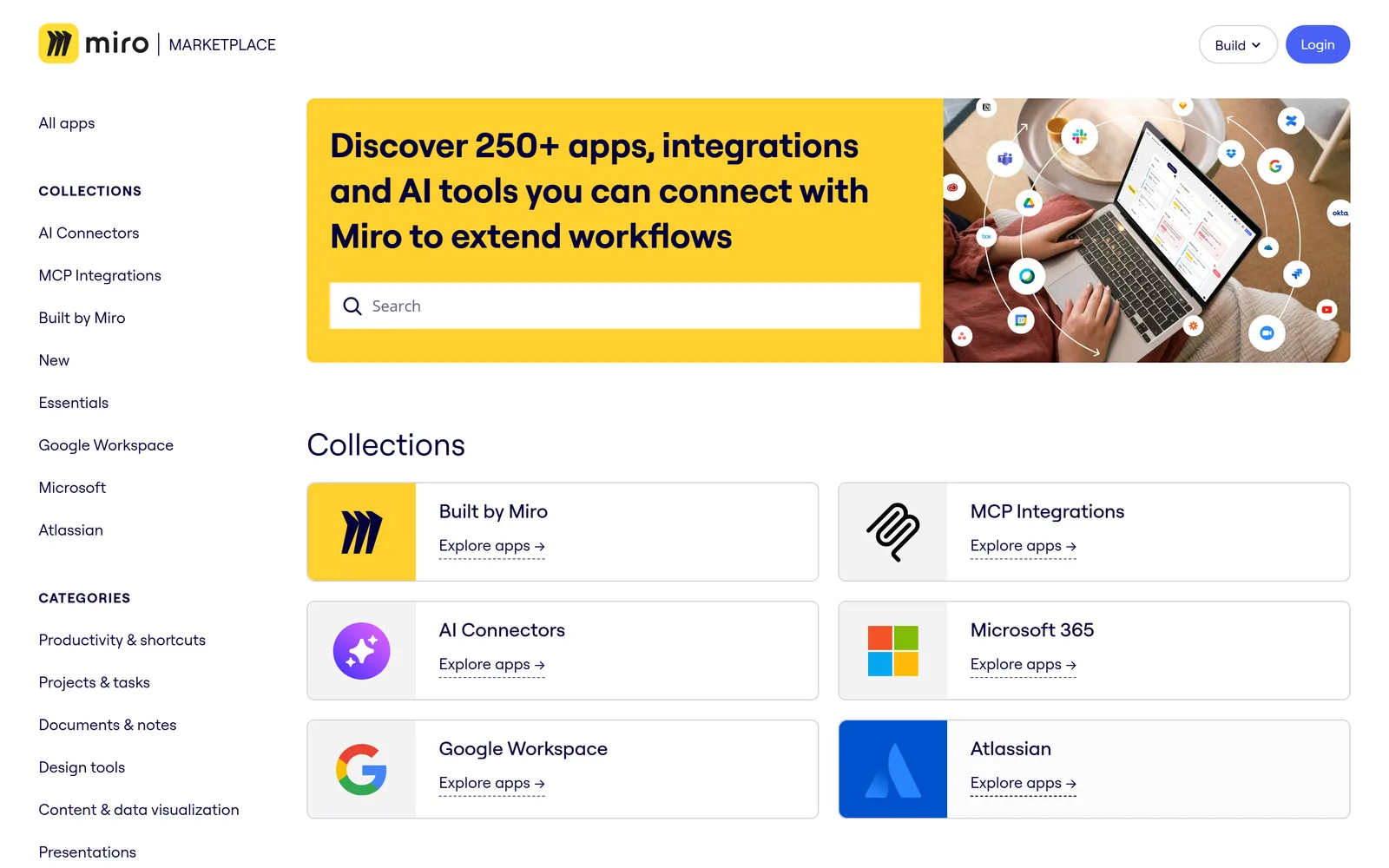
Miro’s Marketplace lists ~250+ apps filterable by Collections, Categories, Use Cases, and Pricing Models. Curated Collections like AI Connectors, MCP Integrations, and Built by Miro do the browsing for you, while cards carry star ratings and install counts (one shows 502K).
Curated collections plus social proof on the card turn a directory into a recommendation engine.
Layout: Searchable directory · Lists: Tech partners, Marketplace apps · Industry: Productivity & collaboration · Built with: First-party · Visit the live page
16. monday.com Marketplace
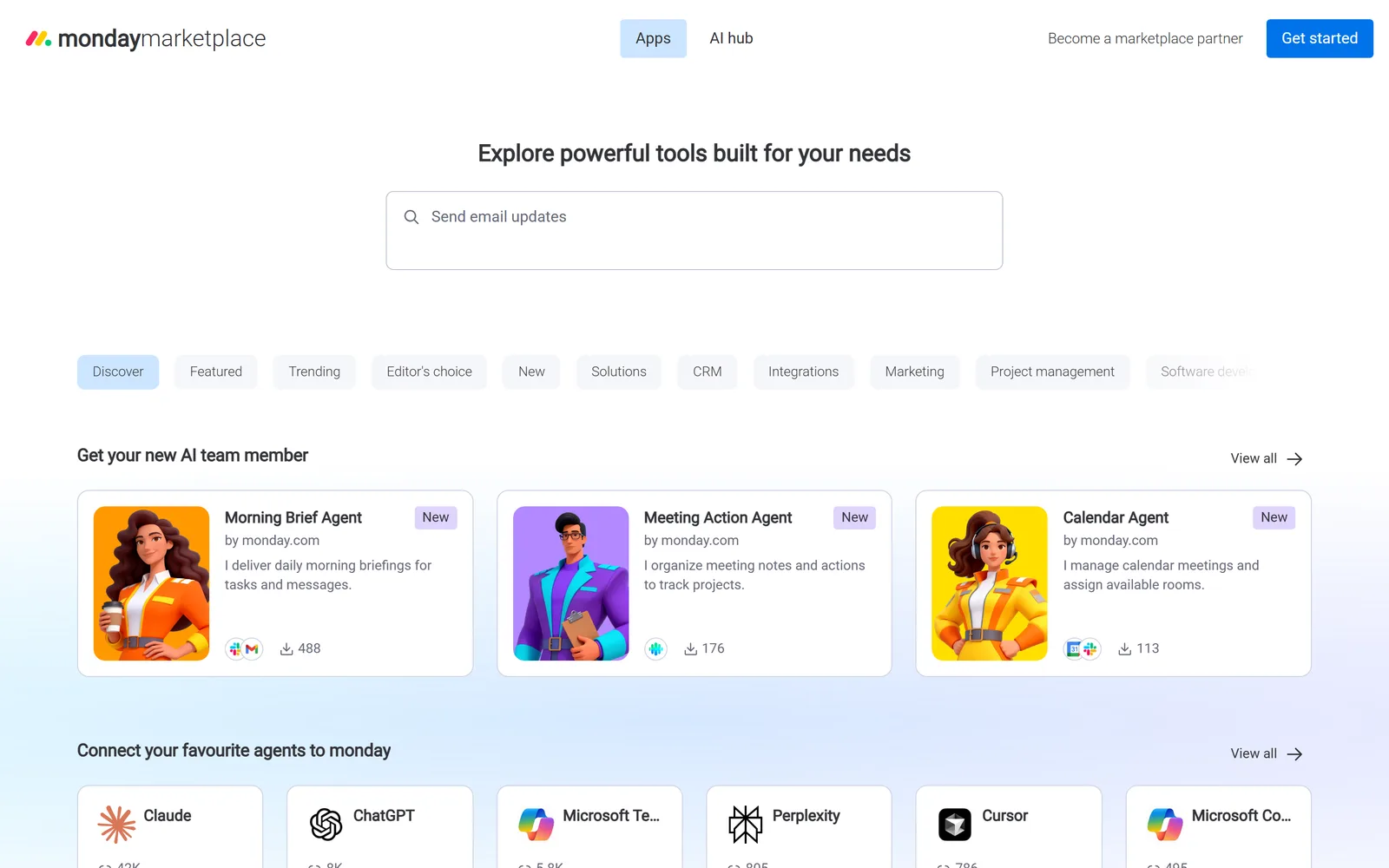
Roughly 827 apps are each filed under up to three predefined categories and surfaced through rotating curated rows like New Apps, Best Sellers, Trending This Week, and Editor’s Choice. Those Featured and Editor’s Choice labels are earned through quarterly internal reviews of usability, pricing, and conversion, so merchandising doubles as quality control.
Curated shelves plus earned badges keep a large catalog feeling fresh and trustworthy.
Layout: Searchable directory · Lists: Marketplace apps, Tech partners · Industry: Productivity & collaboration · Built with: First-party · Visit the live page
17. NetSuite SuiteApp.com Marketplace
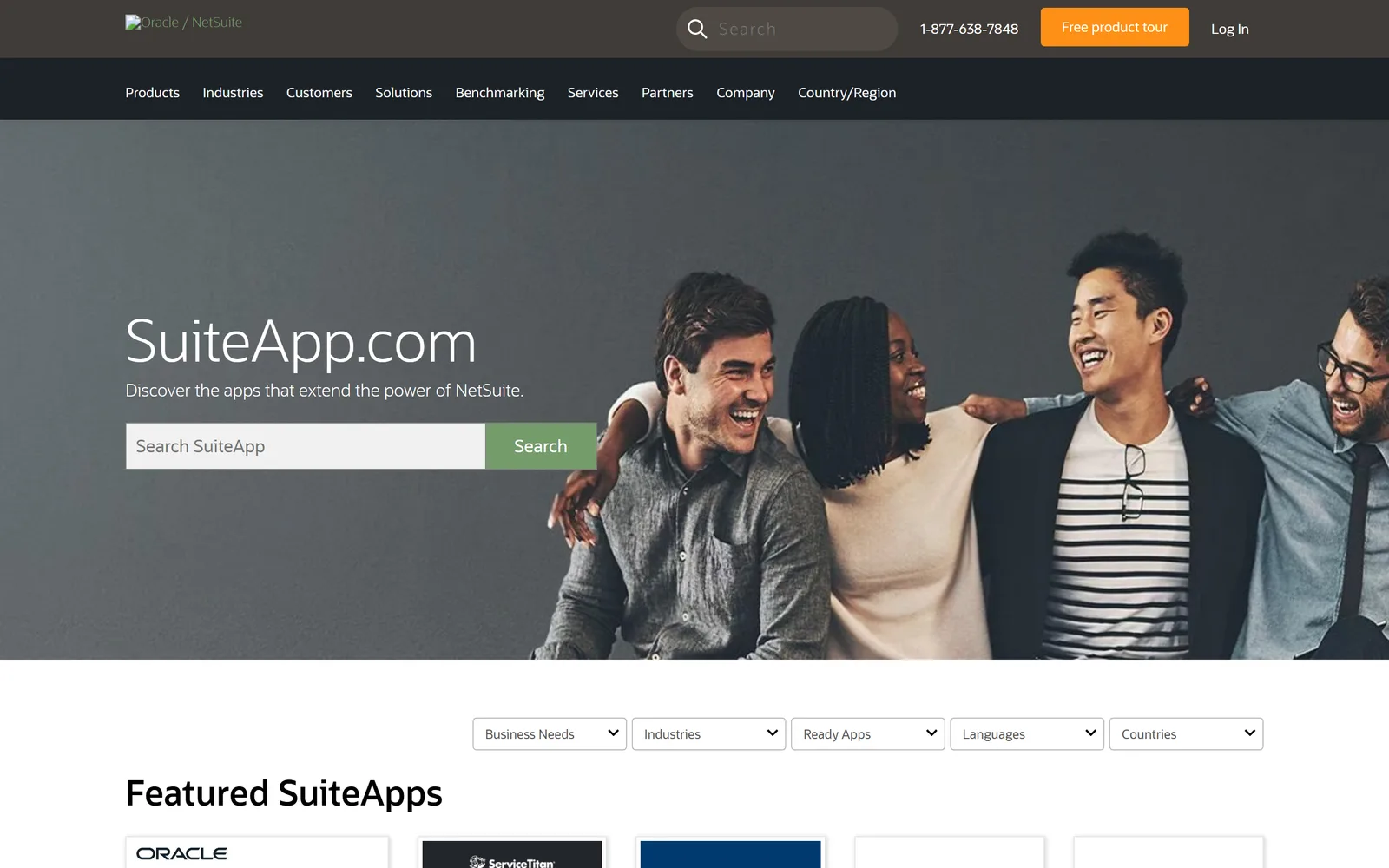
SuiteApp.com is a searchable directory of 700+ SuiteApps, filterable by industry, category, NetSuite edition compatibility, and region. Verification is the point here: “Built for NetSuite” badges (Native, Integrated, Hybrid) that Oracle re-tests against every platform upgrade, plus customer reviews validated before publication.
Gating listings through a review process turns the directory itself into the partner-program funnel.
Layout: Searchable directory · Lists: Marketplace apps, Tech partners · Industry: Accounting · Built with: First-party · Visit the live page
18. Notion Connections
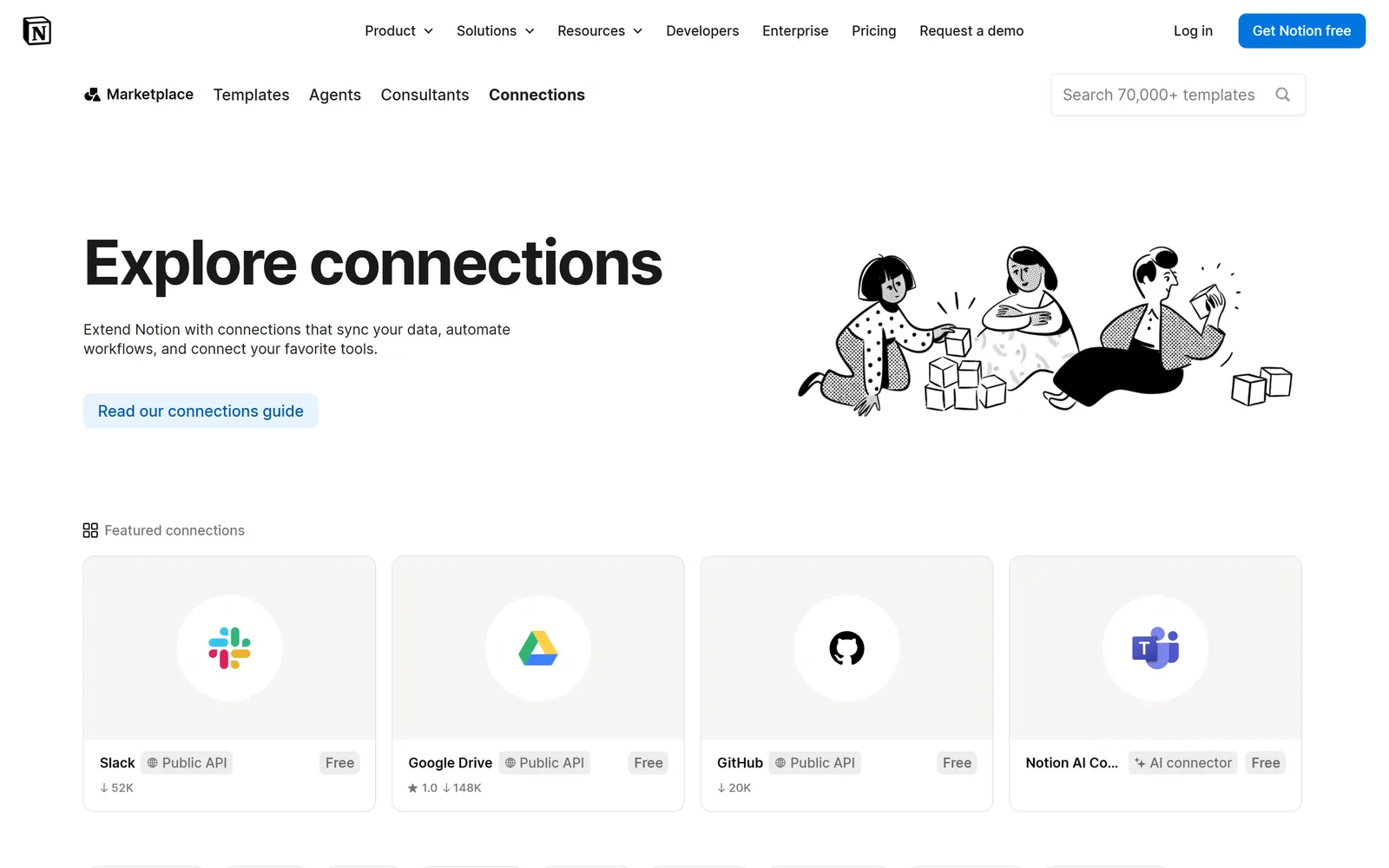
50+ connections across five paginated pages can be searched or filtered by connection type (Public API, AI connector, Embed, SCIM/SSO) and category tags like Engineering, Sales, and Automations. Social proof sits on the cards themselves: usage counts like 52K and 148K, plus Free pricing badges.
A “Made by Notion” filter cleanly separates first-party connectors from technology partners, worth copying if you list both.
Layout: Searchable directory · Lists: Tech partners, Marketplace apps · Industry: Productivity & collaboration · Built with: First-party · Visit the live page
19. Paylocity Marketplace
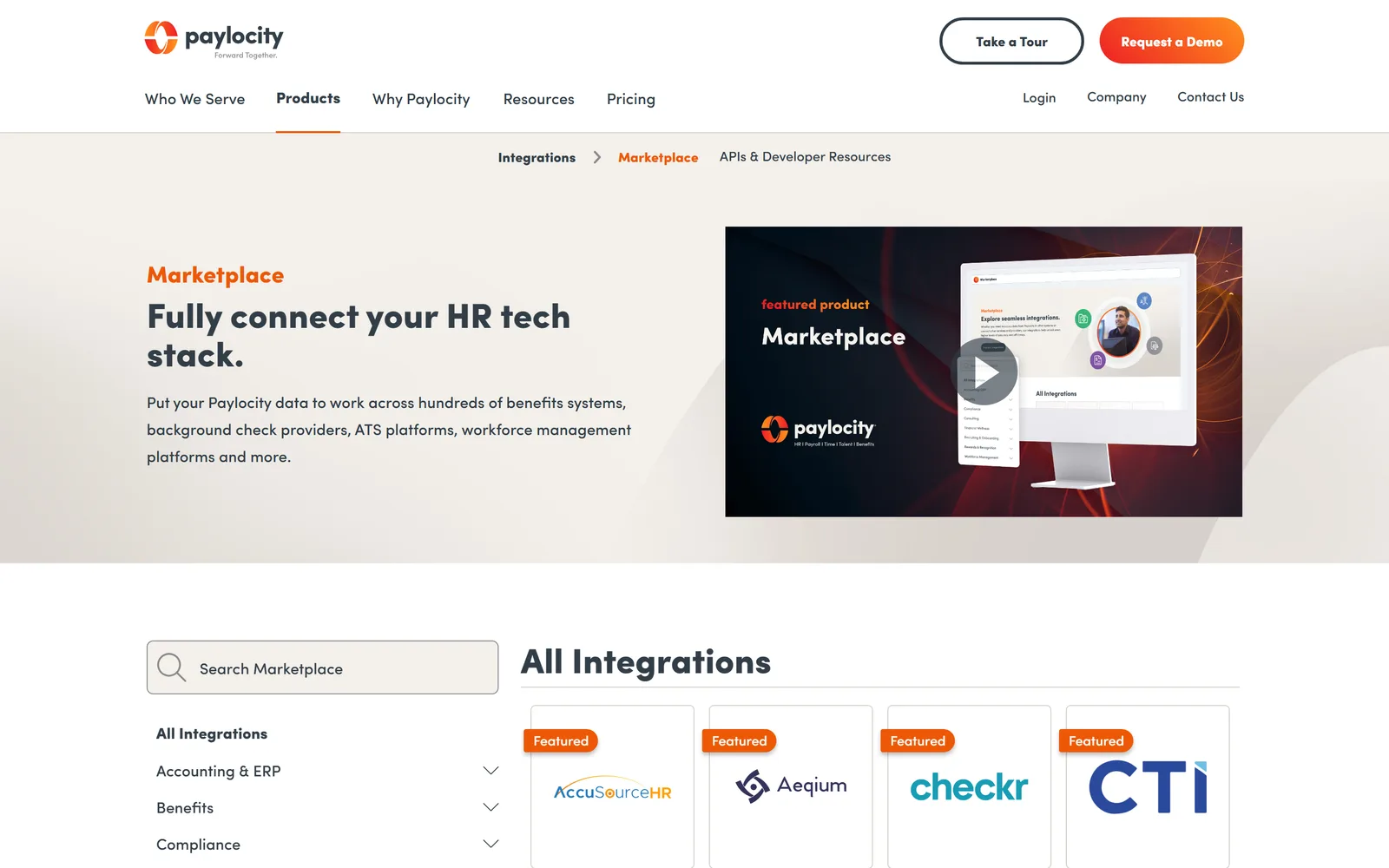
Every one of the roughly 430 integrations in Paylocity’s Marketplace gets its own detail page under a clean /marketplace/<slug>/ URL, searchable and filterable across 11 category facets like Benefits and Workforce Management. Featured and New badges surface fresh listings first, and a “Partner with Paylocity” CTA feeds its tiered Accelerate Partner Program.
Copy the per-partner URLs; skip the logo-only cards, which hide partner names from search engines.
Layout: Searchable directory · Lists: Tech partners, Marketplace apps · Industry: HR & payroll · Built with: First-party · Visit the live page
20. Procore App Marketplace
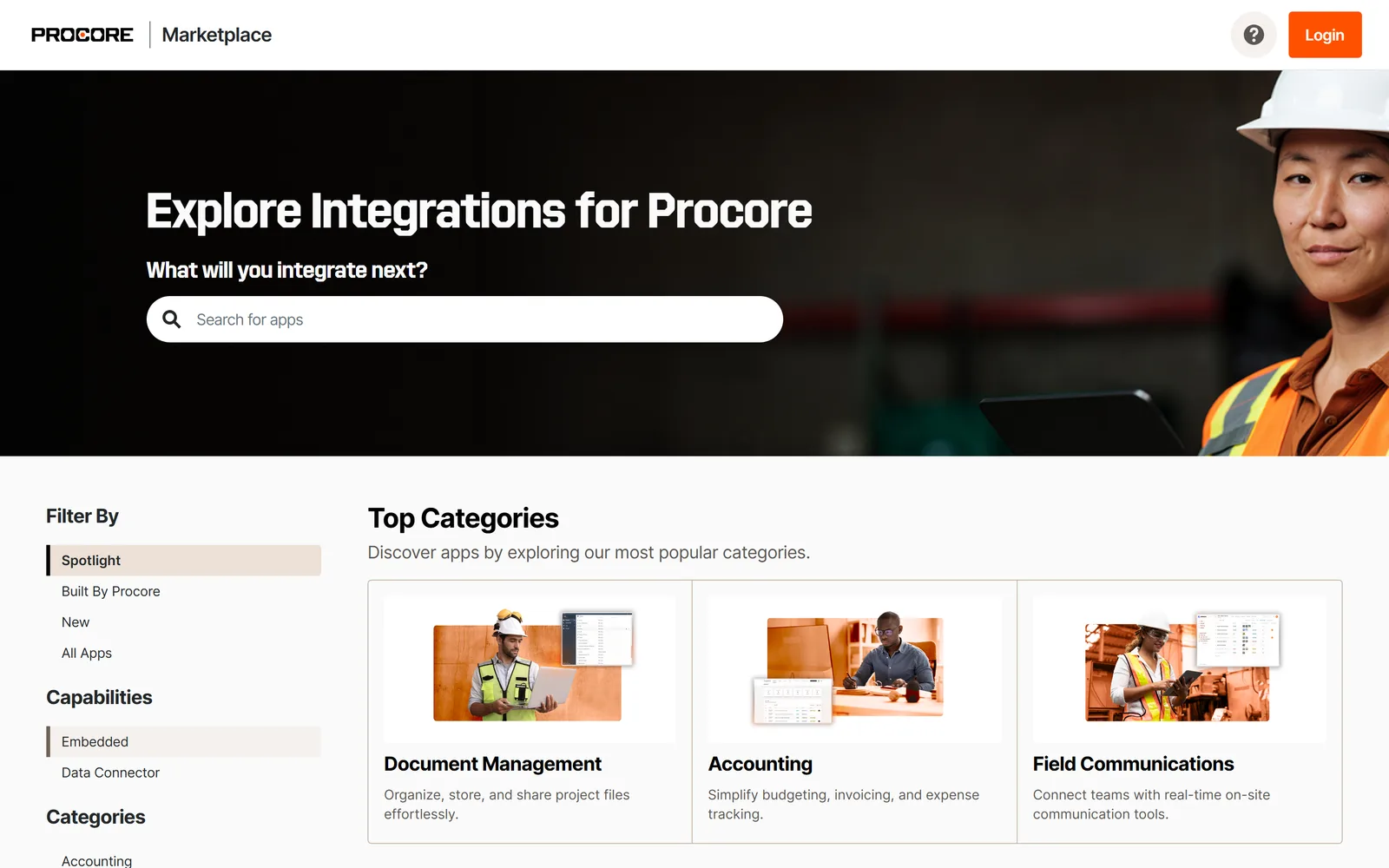
500+ integrations span 25 categories, from accounting and compliance to drone technology, with search and filters over the top. Two designations do quiet trust work: a “Built by Procore” badge for first-party apps and a “Beta” label for trial-phase ones, alongside a split between installable Marketplace Apps and one-off Custom Integrations.
The copyable move is the “Submit your idea” section, which turns the directory into a roadmap-input channel.
Layout: Searchable directory · Lists: Tech partners, Marketplace apps · Industry: Construction · Built with: First-party · Visit the live page
21. Ramp Integrations
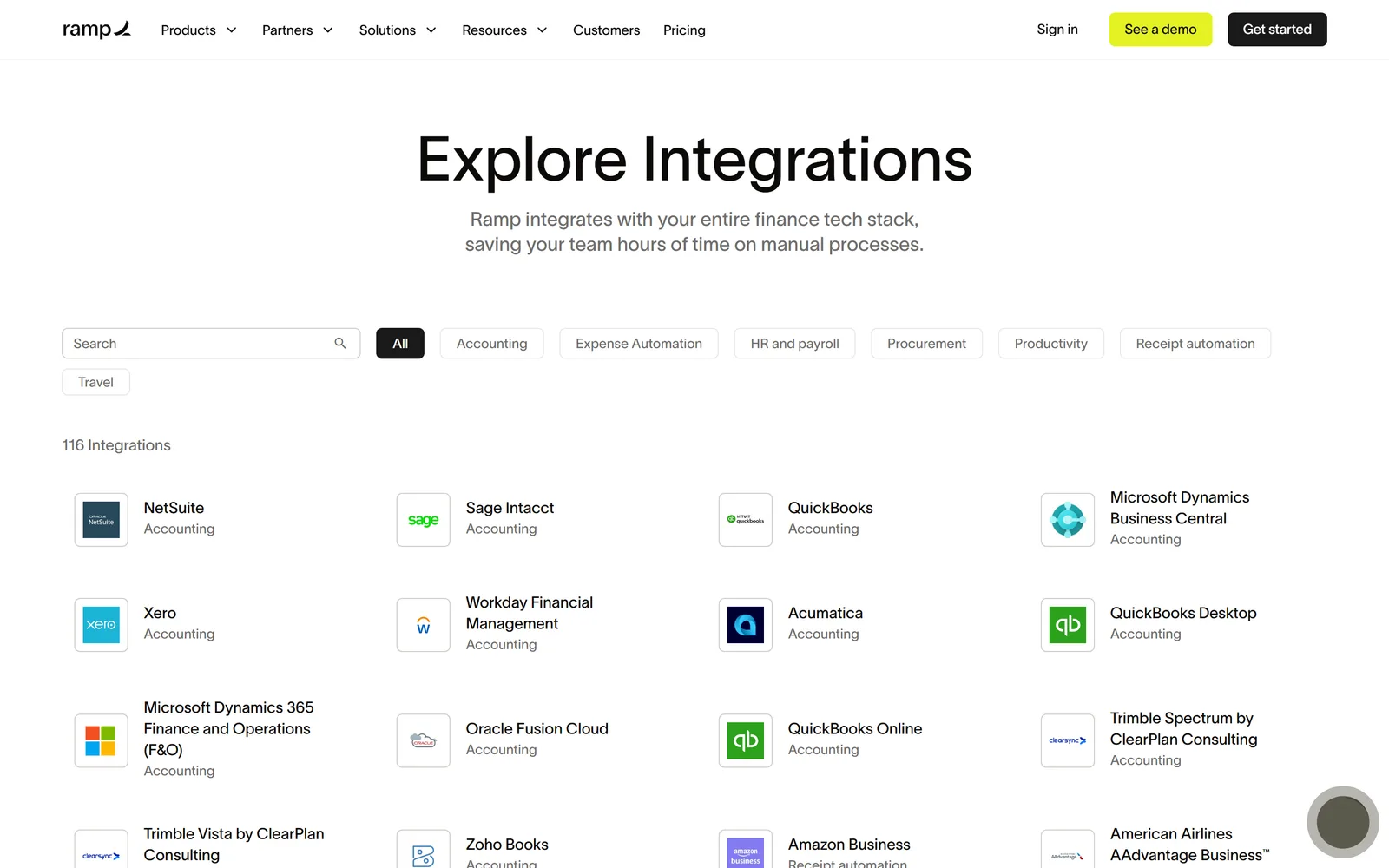
A single category bar with 8 facets, from Accounting to Travel, filters 116 integrations, with accounting tools like NetSuite and QuickBooks listed first. Every card links to a dedicated detail page at /integrations/<name>, and a request-an-integration form invites users to shape the roadmap.
No badges or review counts needed when the category bar and per-integration pages carry the weight.
Layout: Searchable directory · Lists: Tech partners, Marketplace apps · Industry: Payments & fintech · Built with: First-party · Visit the live page
22. Salesforce AppExchange
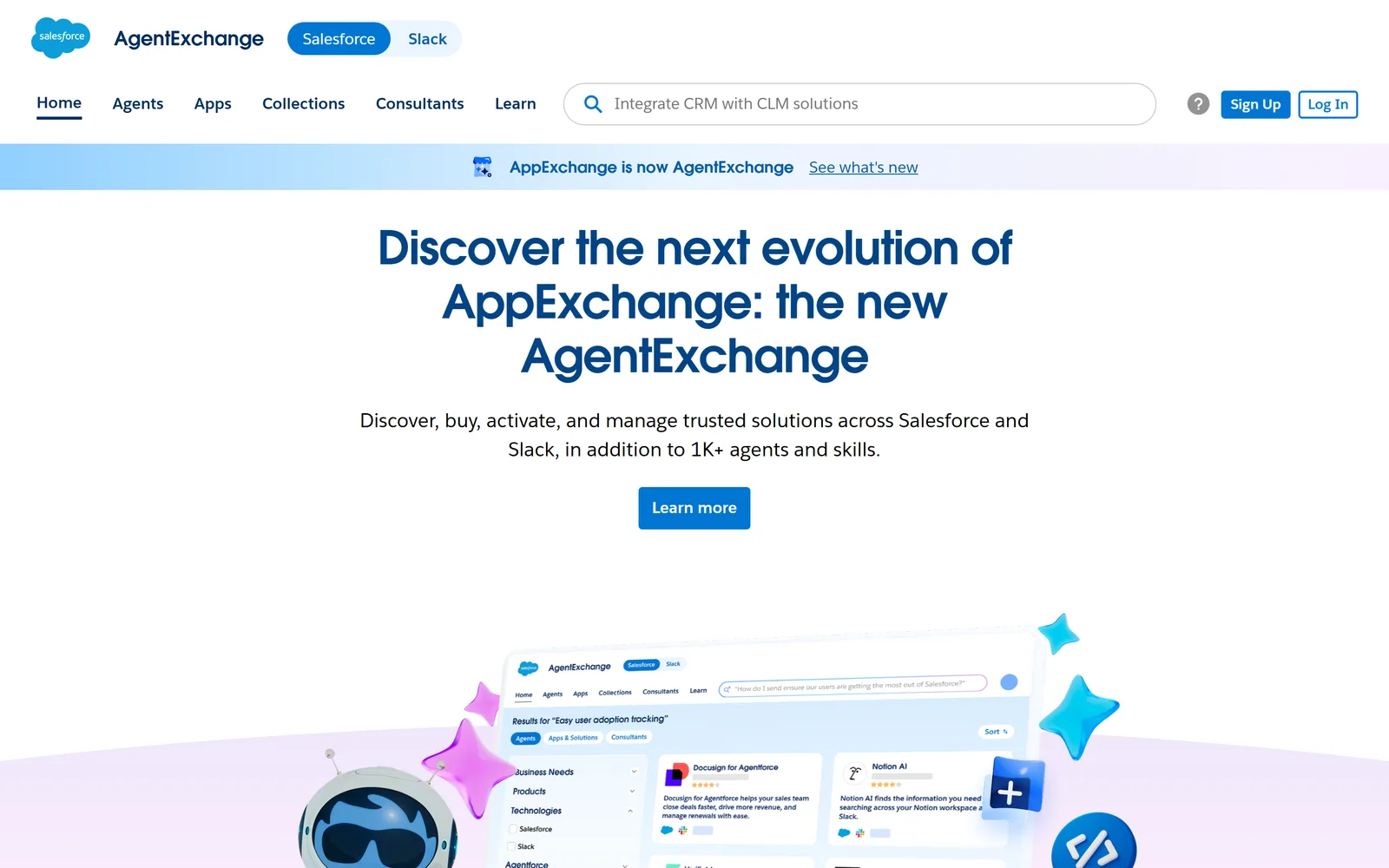
Roughly 6,000-7,000 apps (plus 1,000+ AI agents since the April 2026 AgentExchange merge) are searchable and filtered by Business Needs, Products, and Industries across 25+ subcategories. Every listing card shows a star rating with its review count, like 4.6 (842), and links to a dedicated detail page.
Curated collections and “Most Popular” rows replace a flat grid, so social proof appears before the click.
Layout: Searchable directory · Lists: Marketplace apps, Tech partners, Agencies · Industry: Sales · Built with: First-party · Visit the live page
23. Samsara Marketplace
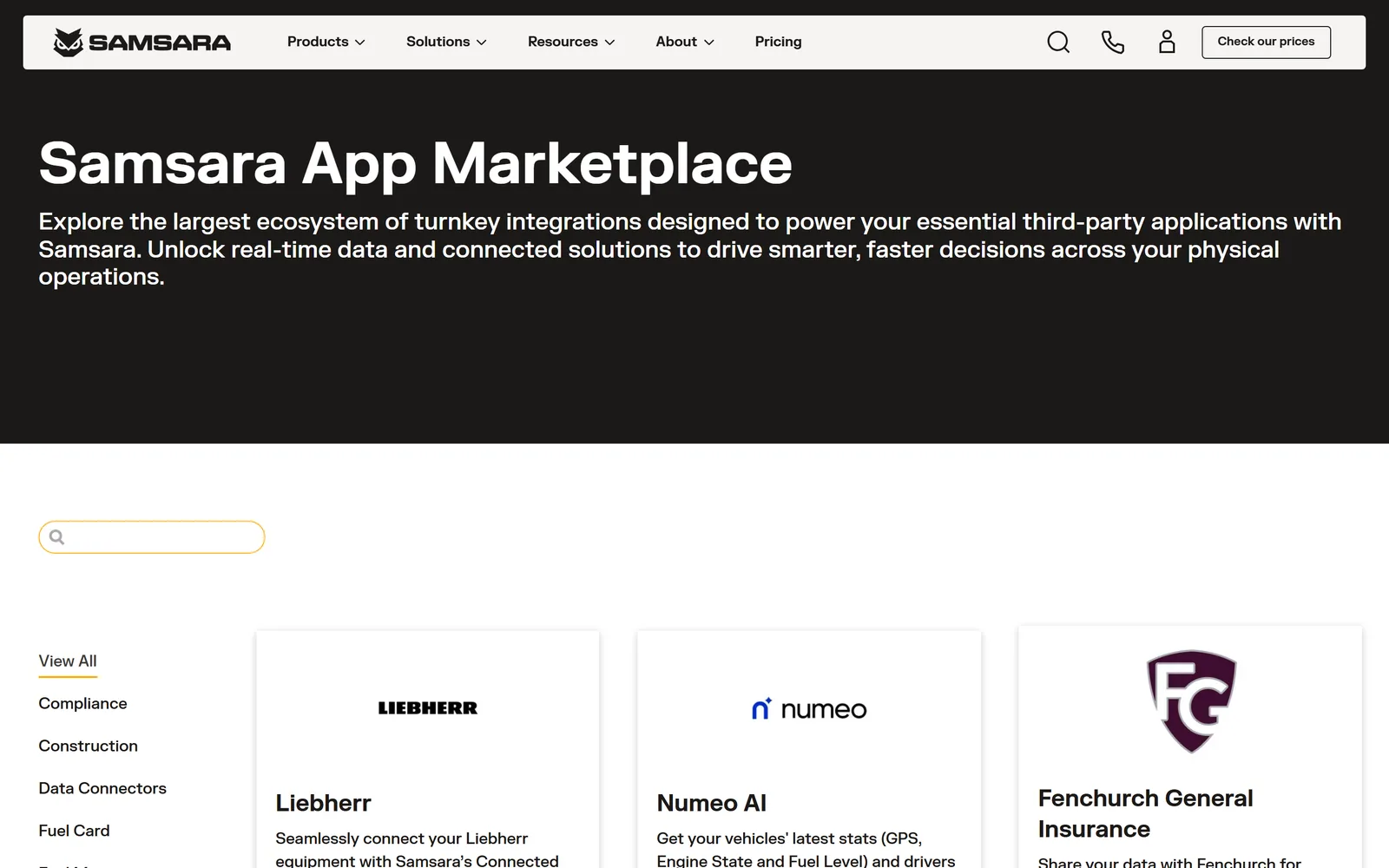
Twenty-one category filters do all the navigation work here: Samsara’s Marketplace puts its 350+ integrations in one paginated grid with no search bar, relying on fleet-specific facets like Fuel Card, Tire Monitoring, and OEM instead. Cards carry “Newly Added” badges alongside category tags, a cheap way to keep a mature directory feeling active.
In a niche industry, precise category names beat a search box.
Layout: Grid · Lists: Tech partners, Marketplace apps · Industry: Logistics & fleet · Built with: First-party · Visit the live page
24. Shopify App Store
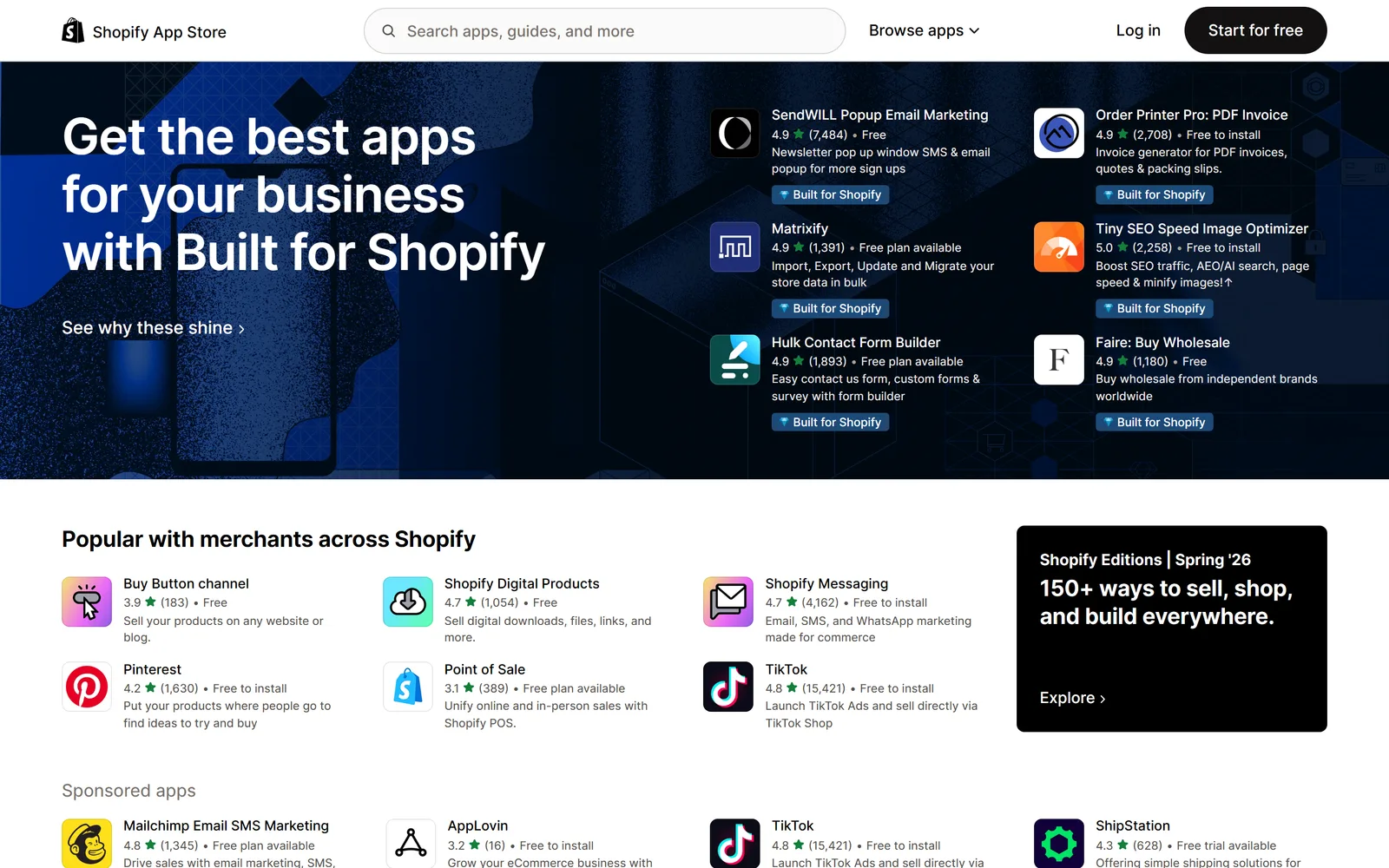
Thousands of apps sit behind seven top-level categories, full search and filters, plus curated homepage collections like “Built for Shopify” and “Made by Shopify”. Every card carries a star rating with large review counts (TikTok: 4.8 stars across 15,421 reviews) and a plain pricing label such as “Free plan available”.
Badge, rating and price all sit on the card itself, so buyers can qualify an app before they ever click through.
Layout: Searchable directory · Lists: Marketplace apps, Tech partners · Industry: E-commerce · Built with: First-party · Visit the live page
25. Square App Marketplace
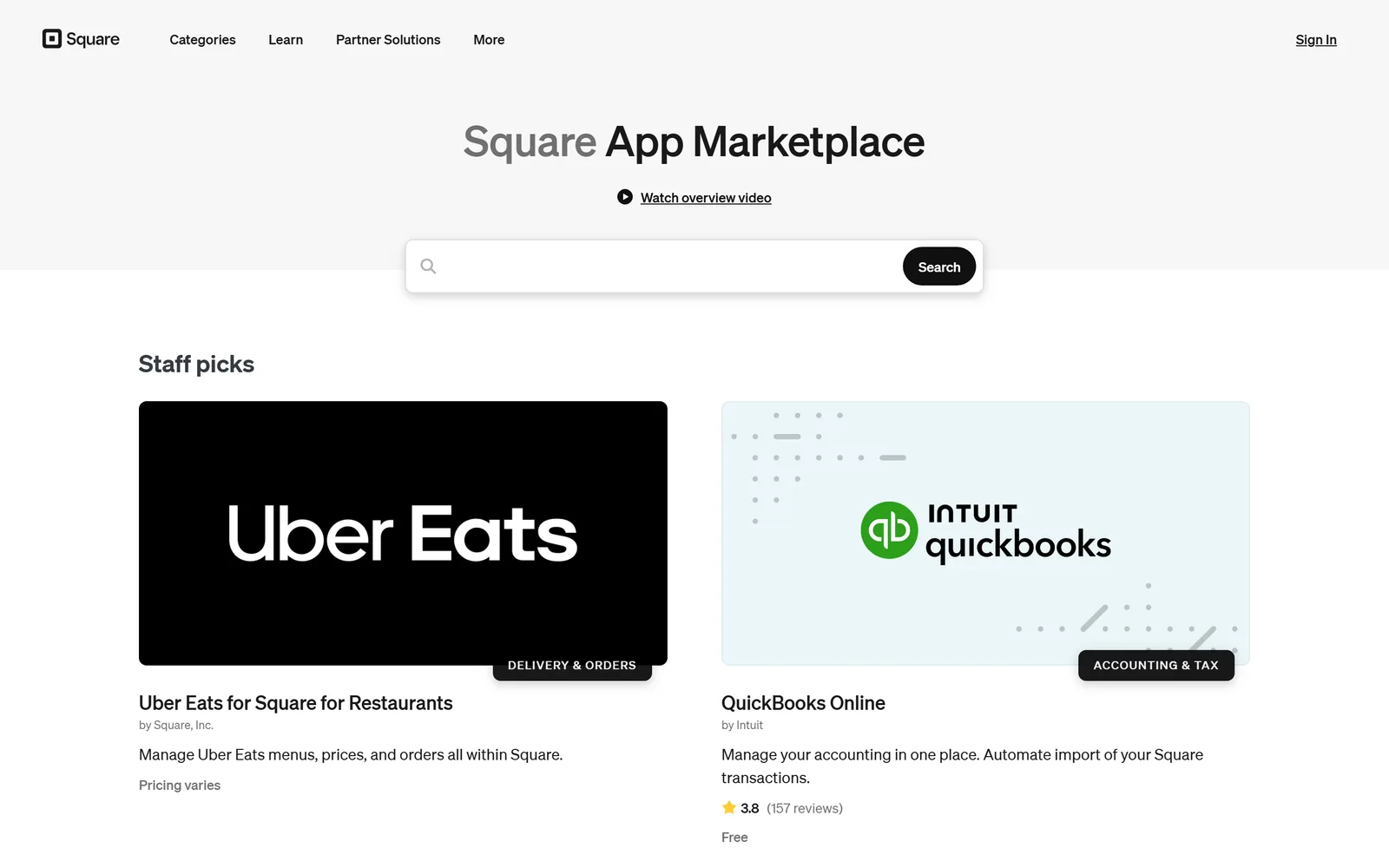
Square’s App Marketplace is a searchable directory of roughly 438 apps, grouped by category like Accounting & Tax, Online Stores, and Inventory Management. Each listing links to its own detail page with a feature list, availability region, and listed/last-updated dates, though no ratings or pricing.
Even at this scale, consistent structured detail pages beat flashy extras, and surfacing the marketplace inside the product dashboard drives adoption.
Layout: Searchable directory · Lists: Tech partners, Marketplace apps · Industry: Payments & fintech · Built with: First-party · Visit the live page
26. Unbounce Integrations
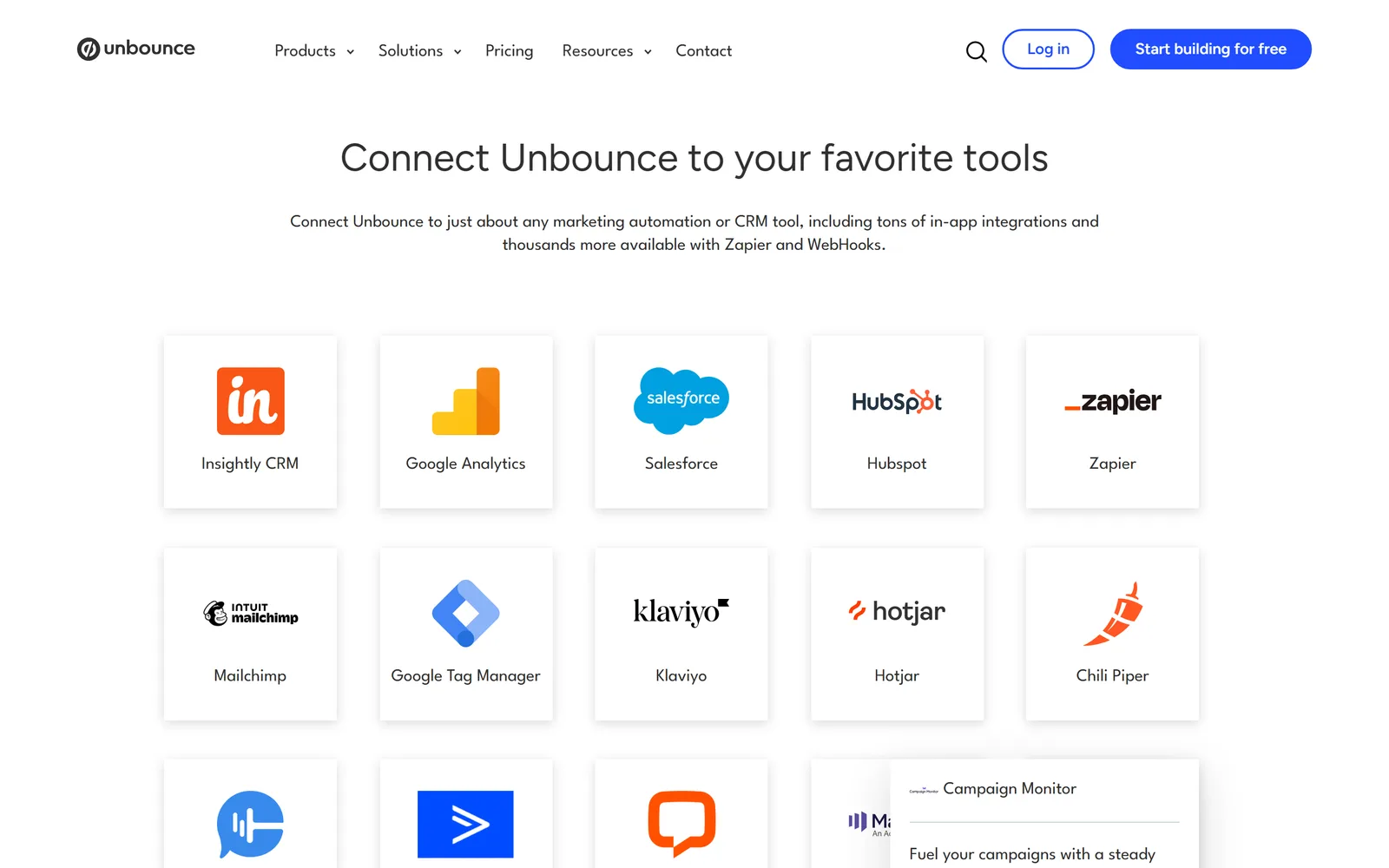
Unbounce went the other way and shrank: it folded its old standalone app market back into the main site, leaving a flat grid of roughly 30 native integrations with no search, filters, or categories. Each card still links to a dedicated detail page, and a fallback section pitches Webhooks and Zapier’s 5,000+ apps for anything missing.
A small, curated grid with strong detail pages can beat a sprawling marketplace you can’t maintain.
Layout: Grid · Lists: Tech partners, Marketplace apps · Industry: Marketing & CRM · Built with: First-party · Visit the live page
27. Webflow Apps Marketplace
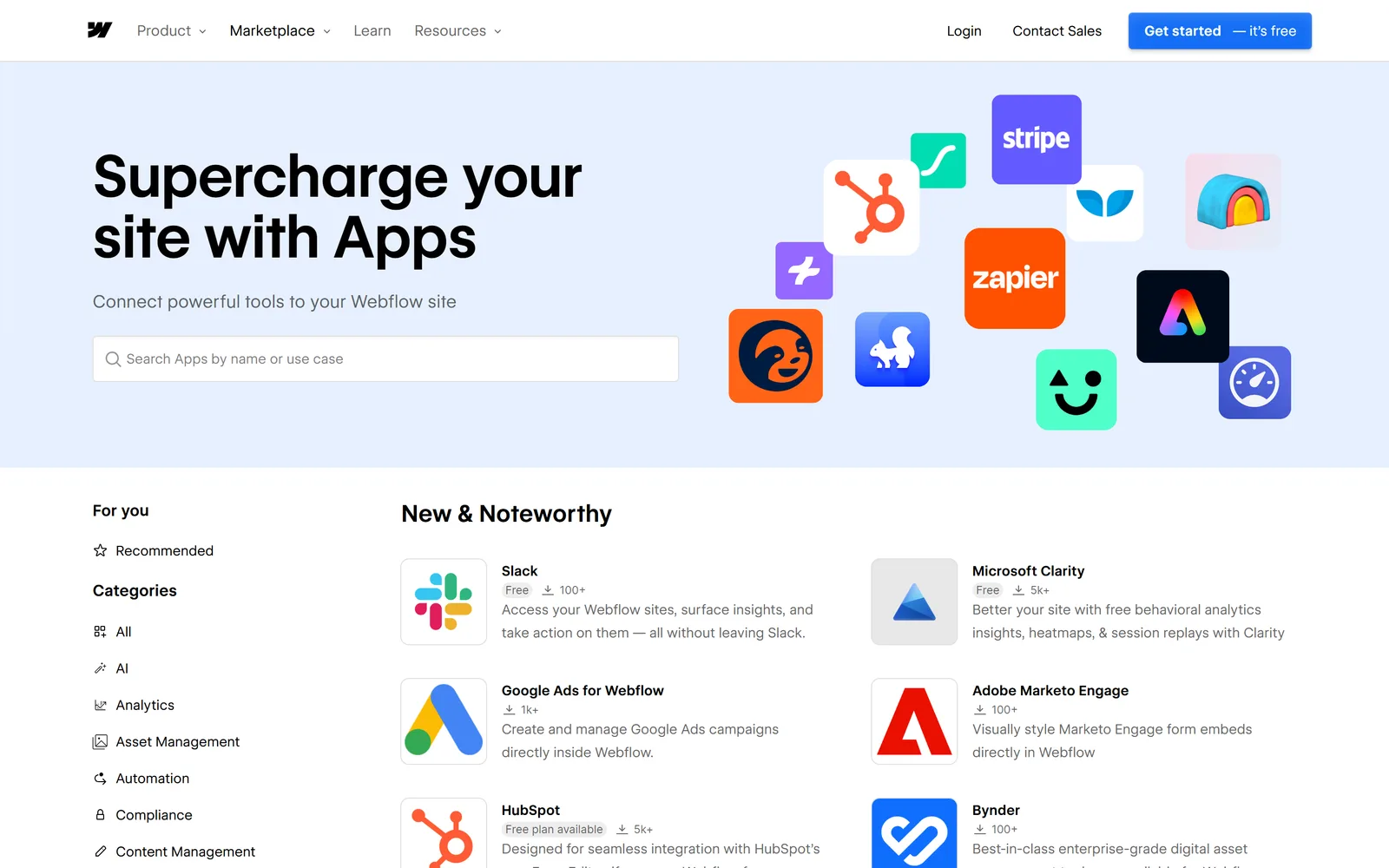
Twenty named categories, from Ecommerce and SEO to a timely “MCP + Agents” bucket, sit alongside search across Webflow’s app marketplace. App cards carry install counts like “5k+” as social proof, while curated “New & Noteworthy” and “Popular” collections surface picks above the main grid.
One small detail earns its place: a “Request an App” link that turns missing integrations into demand signals.
Layout: Searchable directory · Lists: Marketplace apps, Tech partners · Industry: Design & web · Built with: First-party · Visit the live page
28. Xero App Store
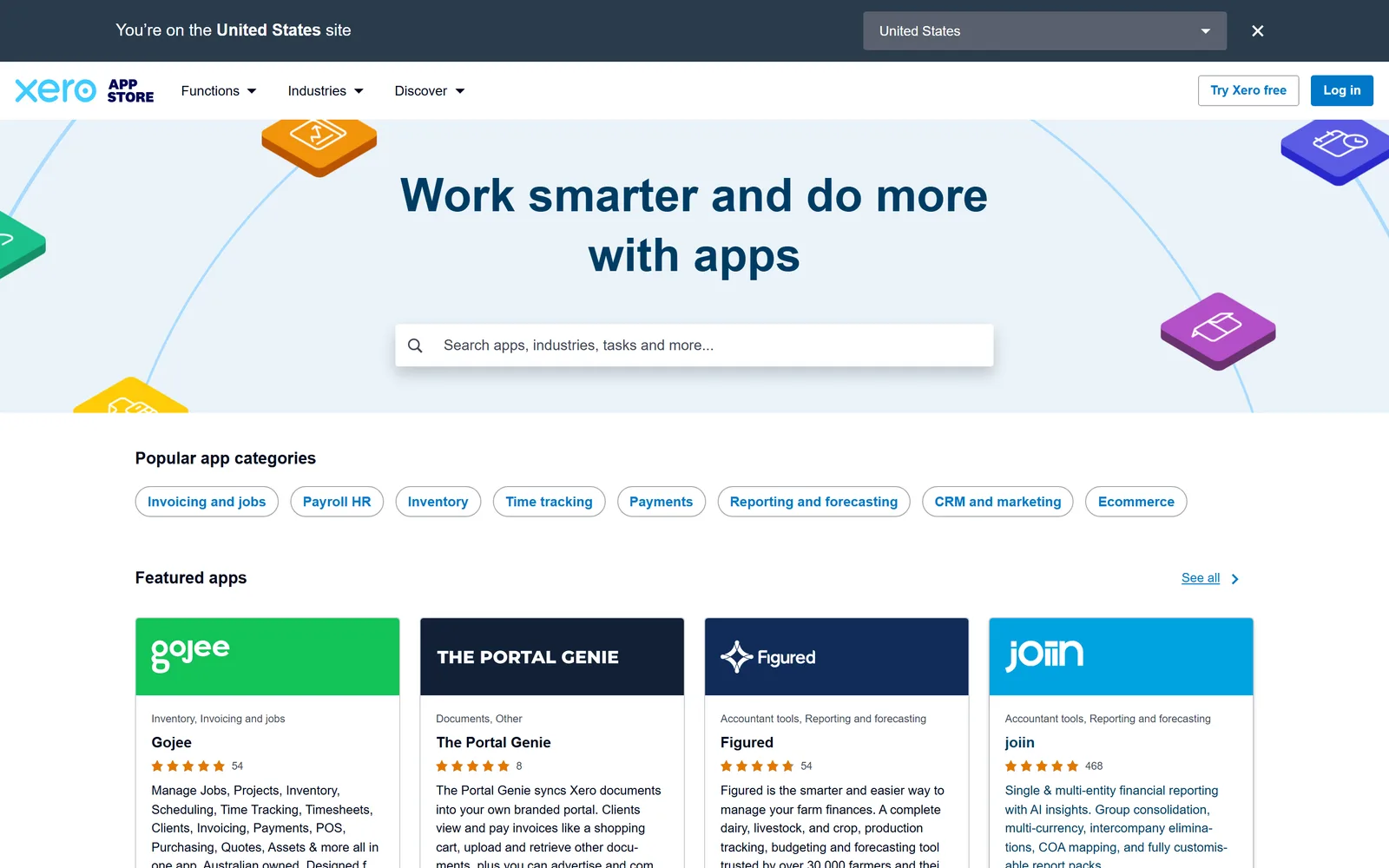
Two filter axes carry Xero’s App Store: business category (Invoicing and jobs, Payroll HR, Payments) and industry, layered over search across 1,000+ certified apps with curated rows like Featured, Most popular, and App Awards finalists. The social proof is refreshingly honest — Dext shows 4.81 stars from 1,111 reviews while Stripe sits at 2.52, and both stay listed.
Publishing real ratings, even ugly ones, is what makes a directory trustworthy.
Layout: Searchable directory · Lists: Tech partners, Marketplace apps · Industry: Accounting · Built with: First-party · Visit the live page
29. Zendesk Marketplace
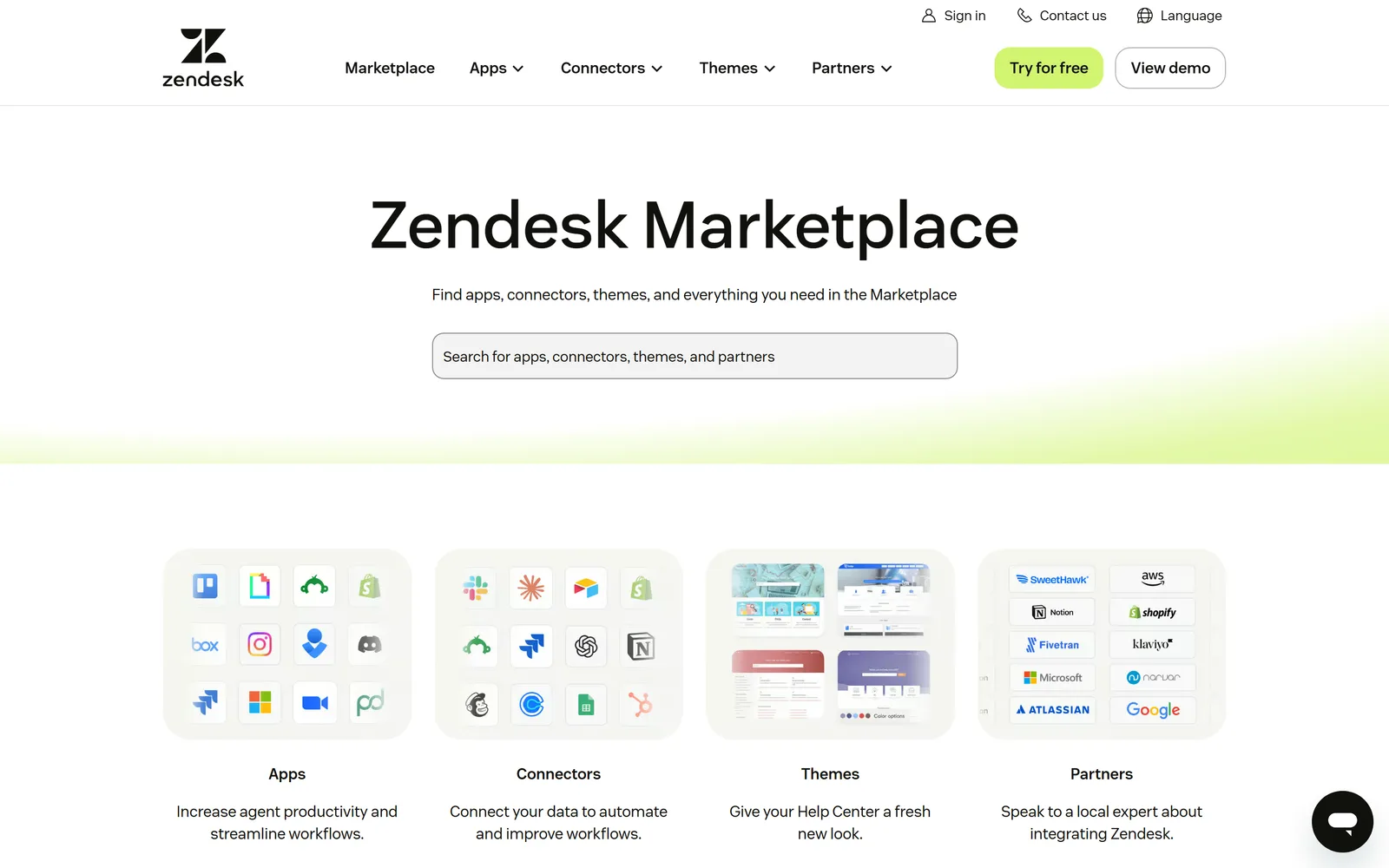
1,783 apps sit alongside connectors, themes, and partners in a searchable directory, with live facet counts on every filter (Agent Productivity 352, AI and Bots 259). Filters map to practical buying criteria: star rating, payment type (Free to install 1,025), and a “Works With” facet that scopes apps to specific Zendesk products.
Show counts on every facet and visitors know a filter is worth clicking before they click it.
Layout: Searchable directory · Lists: Marketplace apps, Tech partners, Agencies · Industry: Customer support · Built with: First-party · Visit the live page
30. Zoom App Marketplace
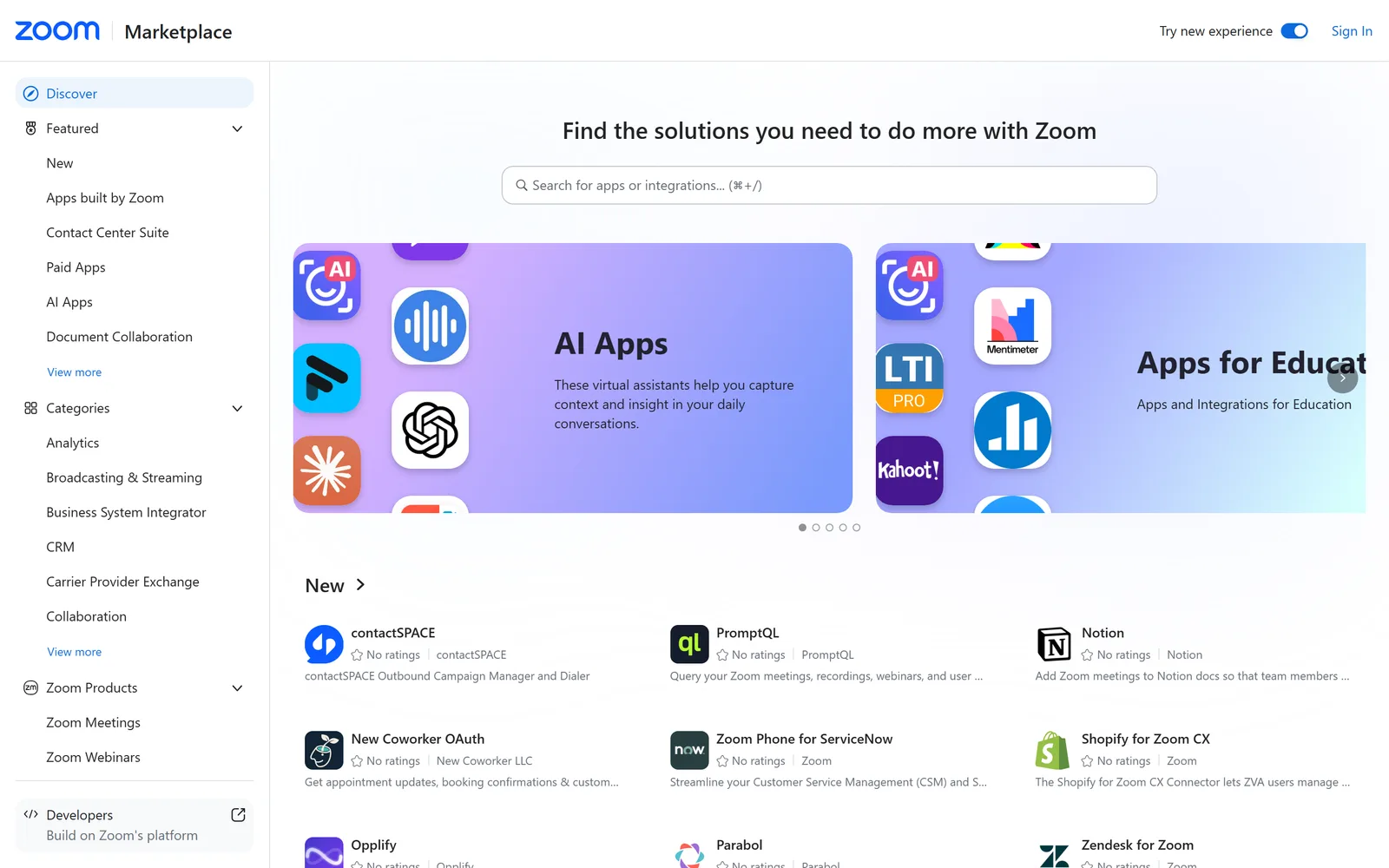
Zoom’s App Marketplace runs three navigation axes in parallel: curated Discover collections (Featured, AI Apps, Paid Apps), 15+ functional categories, and filtering by Zoom product like Meetings or Phone. Every app card also shows a star rating, a review system most partner directories lack.
Let visitors browse by their problem, their category, or your product line, then let ratings do the vetting.
Layout: Searchable directory · Lists: Marketplace apps, Tech partners · Industry: Communications · Built with: First-party · Visit the live page
Agency and service partner directories
These list firms rather than software, so the visitor’s job changes: they are picking who to hire. Tiers, regions, services and budget filters do the work here, and several of these pages add a concierge matching flow on top.
31. Attentive Partner Directory
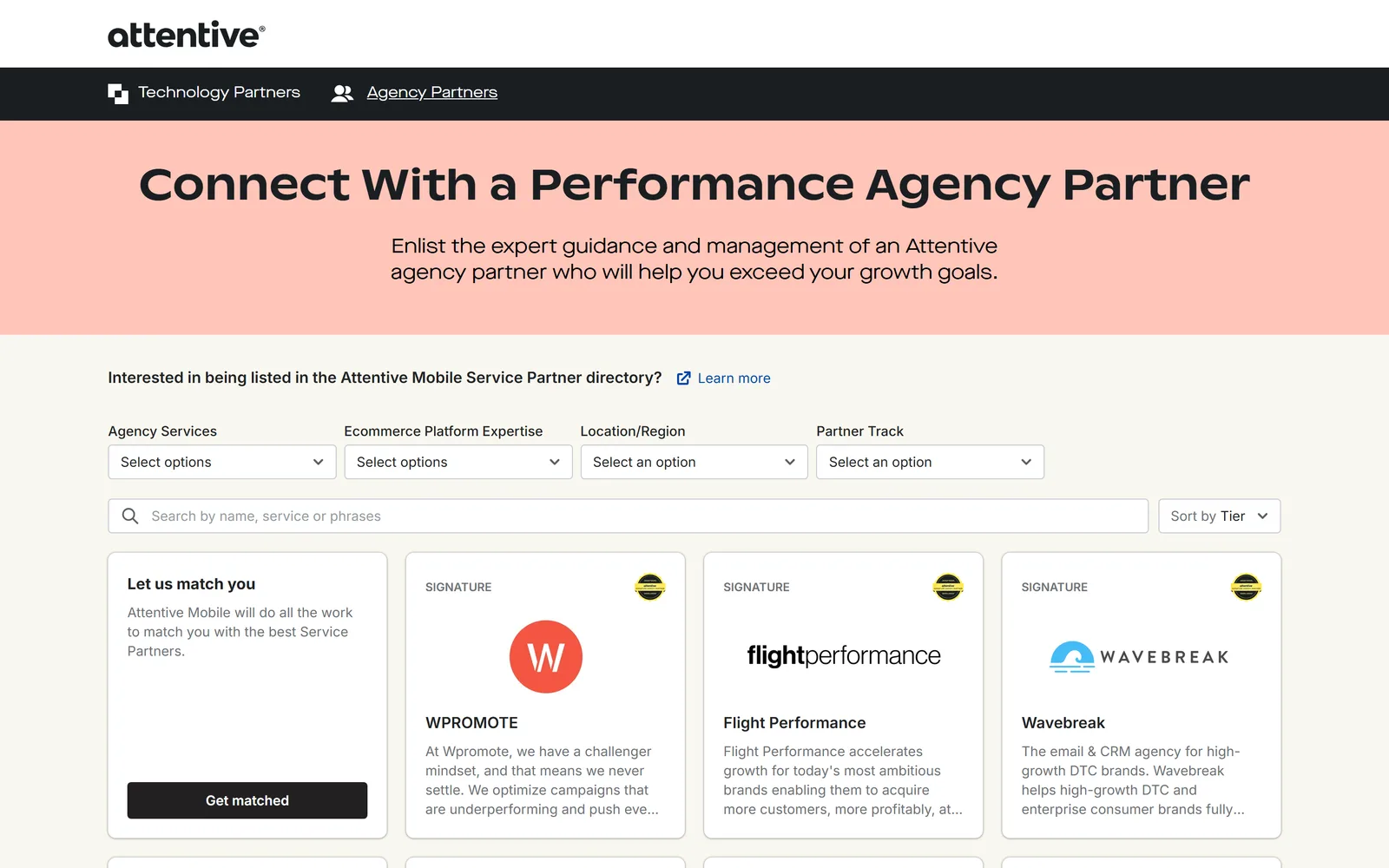
Four facets do the organizing here: Agency Services, Ecommerce Platform Expertise, Location/Region, and Partner Track, over a flat searchable card list of 25+ agencies sortable by Name or Tier. Signature and Premier badges rank partners on the cards, and a “Get matched” button adds concierge matching beside self-serve browsing.
It lists agencies only, since the 100+ tech integrations live elsewhere, and it runs on PartnerPage.
Layout: Searchable directory · Lists: Agencies · Industry: Marketing & CRM · Built with: PartnerPage · Visit the live page
32. DripJobs Trusted Partners
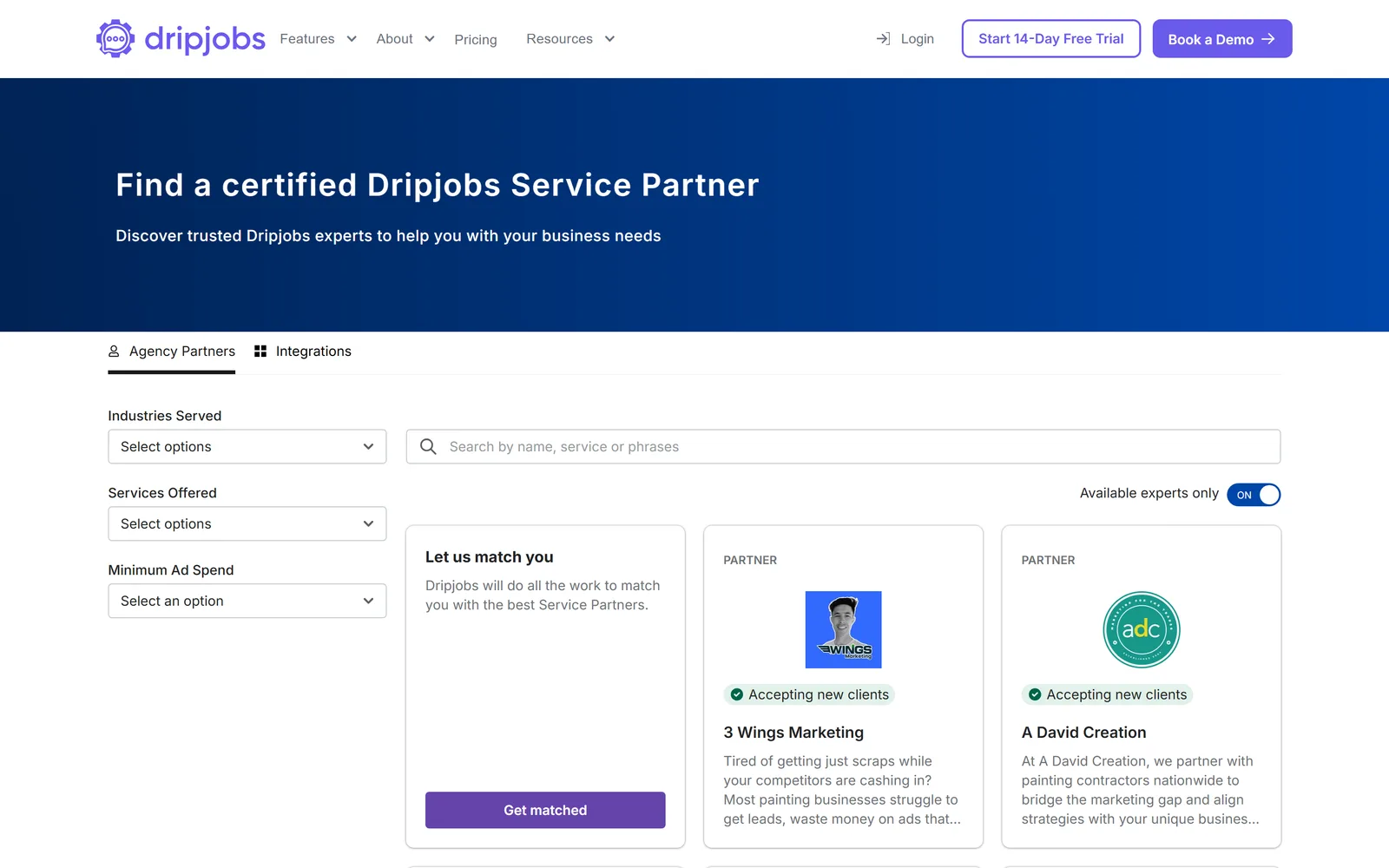
A rare example of an agency-only directory: 30+ certified service partners in a flat, searchable list, filterable by Industries Served, Services Offered, and Minimum Ad Spend. That ad-spend facet is the smart bit, since DripJobs’s contractor users are really shopping for marketing agencies within a budget.
An on-by-default “Available experts only” toggle hides agencies that aren’t taking work, and a “Let us match you” button captures leads. It runs on PartnerPage.
Layout: Searchable directory · Lists: Agencies · Industry: Marketing & CRM · Built with: PartnerPage · Visit the live page
33. Nosto Partner Directory
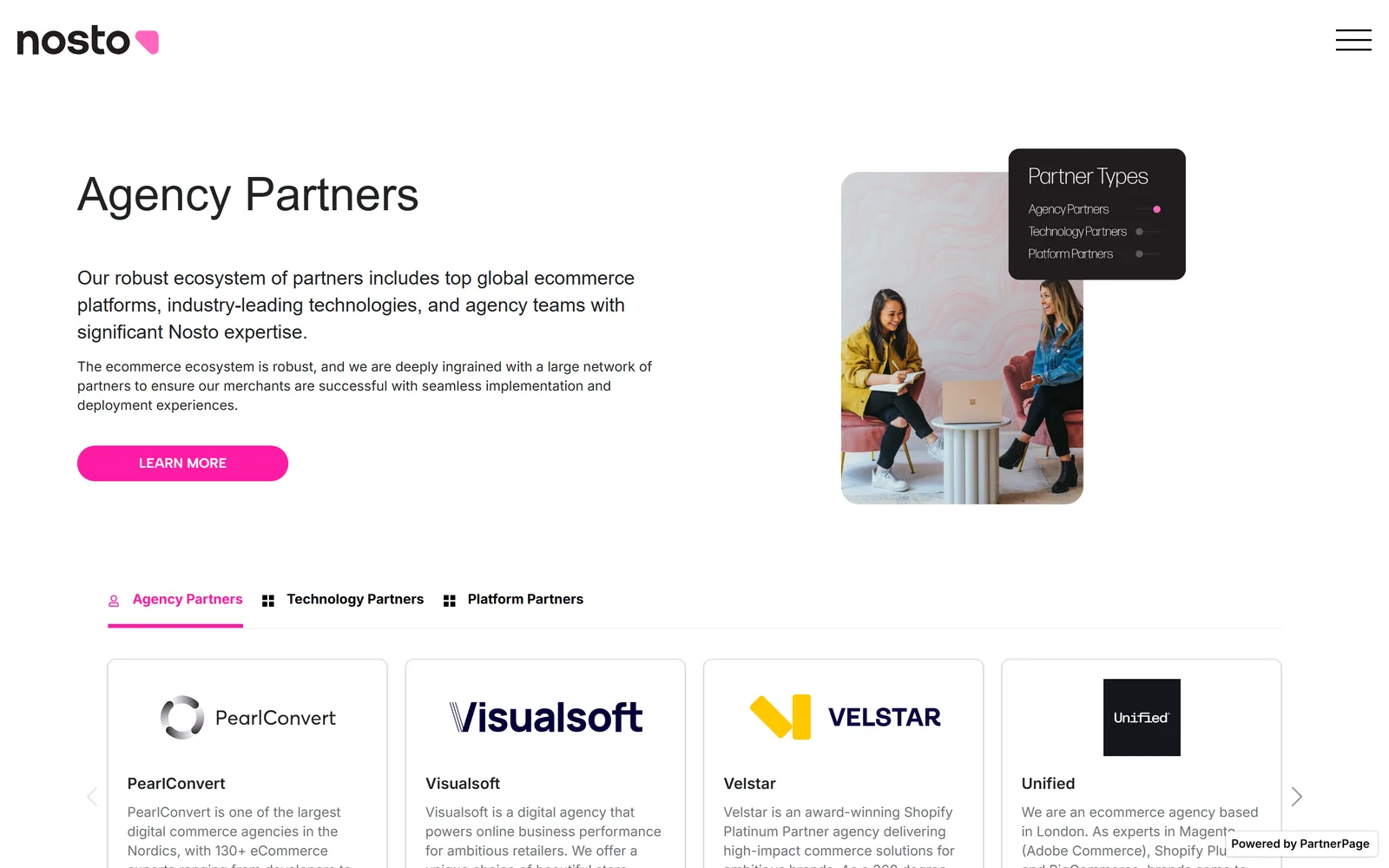
Nosto’s directory splits partners into three sections (Agency Partners, Technology Partners, Platform Partners), landing on a grid of 50+ agencies filterable by location and services. Its distinctive move is credibility borrowing: agency cards surface third-party credentials like Shopify Platinum Partner instead of Nosto’s own tier badges.
Hosted on partners.nosto.com via PartnerPage, it shows a directory can skip search entirely when two well-chosen filters do the work.
Layout: Grid · Lists: Agencies, Tech partners · Industry: E-commerce · Built with: PartnerPage · Visit the live page
34. Ometria Tech Partner Directory
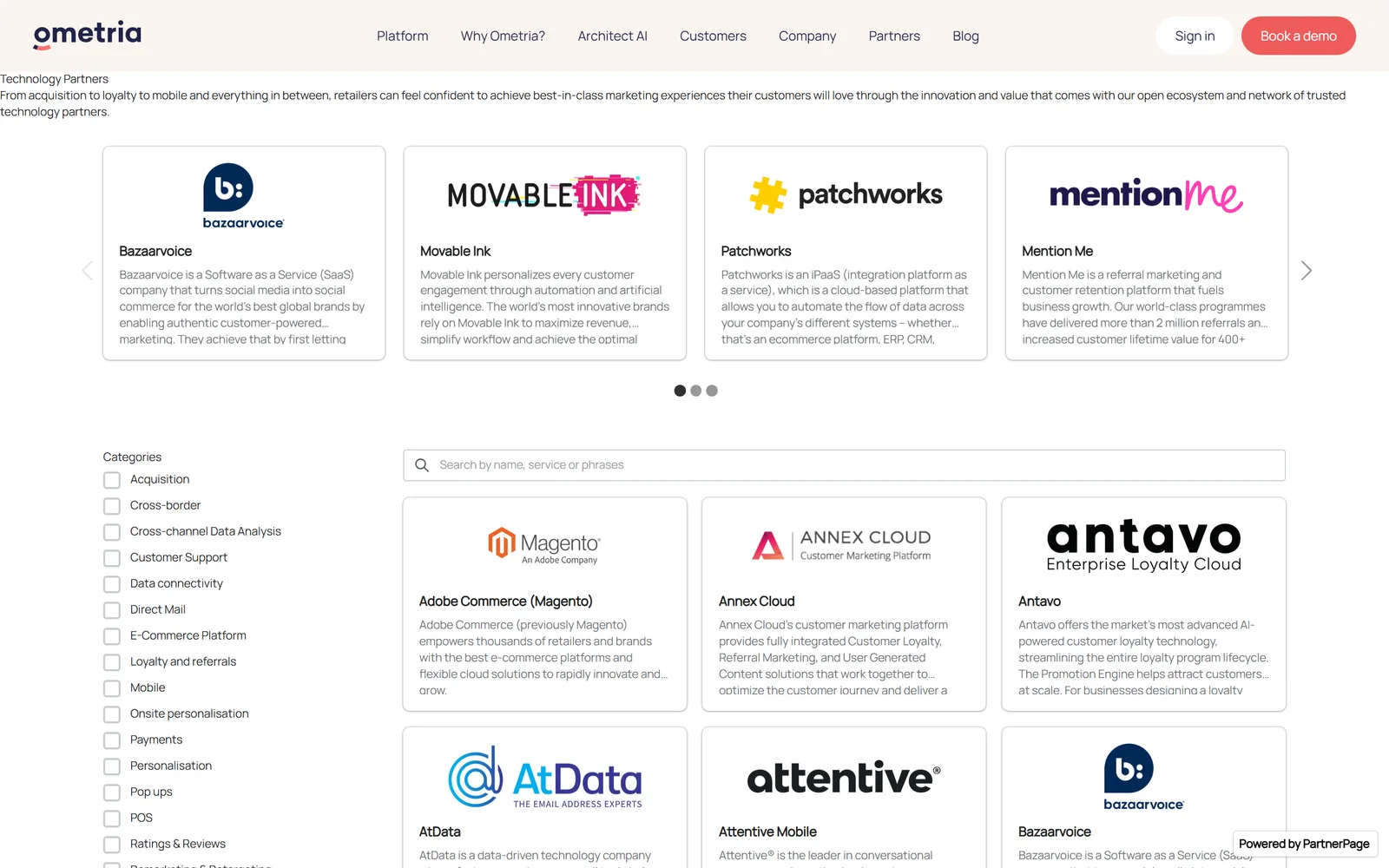
Tech partners can be browsed in category carousel rows or narrowed with roughly 20 filters, from Loyalty and referrals to Ratings & Reviews, across a catalog of 40+. Ometria runs the whole thing on PartnerPage, splitting tech partners and agencies into separate directories with “Book a demo” CTAs throughout.
Separating the two audiences keeps each browsing path clean.
Layout: Grid · Lists: Tech partners, Agencies · Industry: Marketing & CRM · Built with: PartnerPage · Visit the live page
35. PostPilot Partner Directory
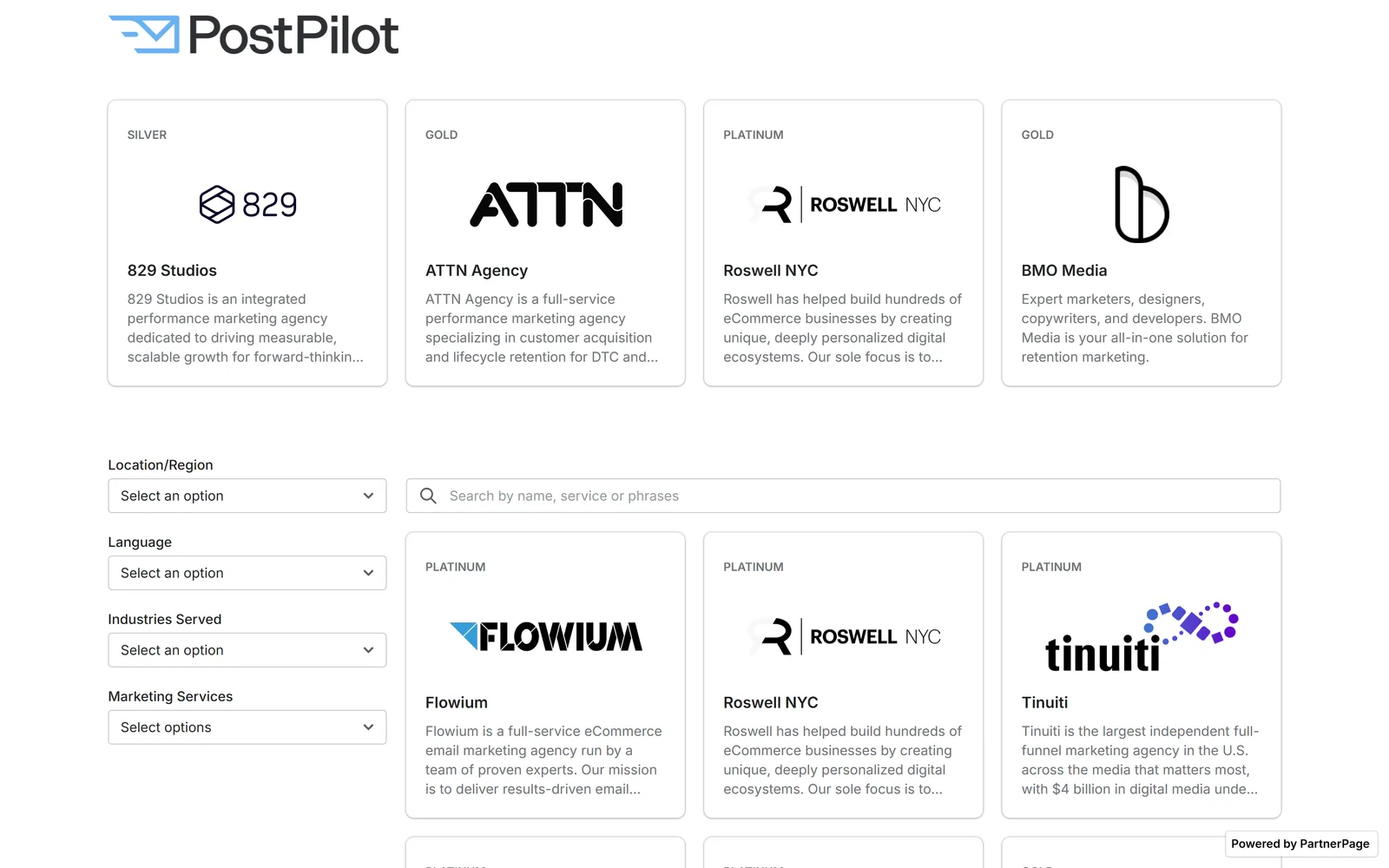
PostPilot’s directory does double duty for the direct-mail platform, splitting service partners at /partners from tech partners at /integrations, with 30+ agencies filterable by region, language, industries served, and marketing services. Platinum, Gold, and Silver badges rank agency cards at a glance, and every listing links to its own detail page.
It runs on a hosted PartnerPage subdomain, proof you can ship tiers and filters without touching your main site.
Layout: Searchable directory · Lists: Agencies, Tech partners · Industry: Marketing & CRM · Built with: PartnerPage · Visit the live page
36. Rally Tech Partners Directory
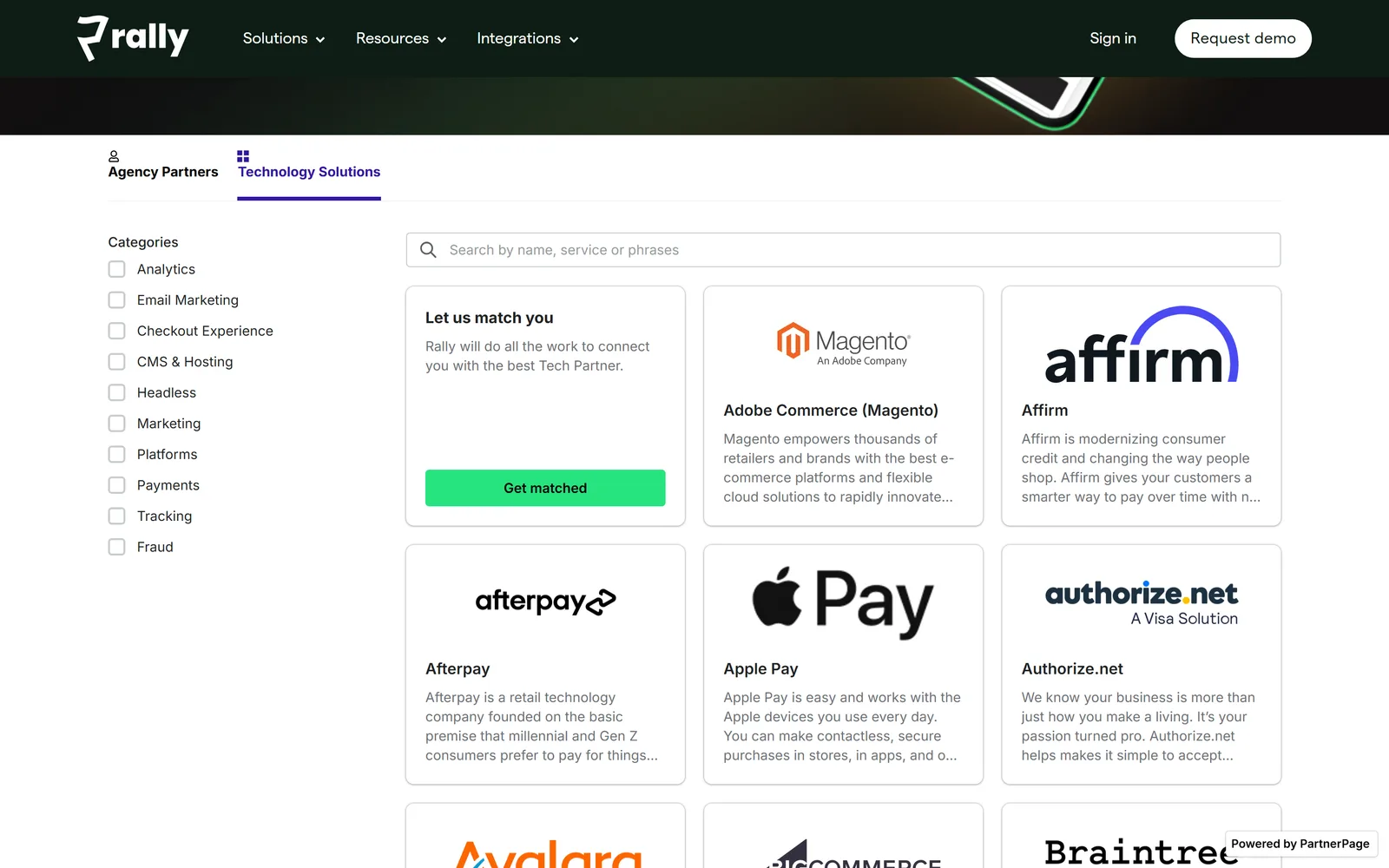
Categories like Checkout Experience, Headless, and Fraud narrow 30+ tech partners, each clicking through to its own detail page. Rally splits its program into two directories, tech partners and agencies, and works both harder than most: an email signup plus a “Let us match you” form turn browsing into leads.
The page runs on PartnerPage, proof a two-sided, lead-generating directory doesn’t require custom build work.
Layout: Grid · Lists: Tech partners, Agencies · Industry: E-commerce · Built with: PartnerPage · Visit the live page
37. Rebuy Partner Directory
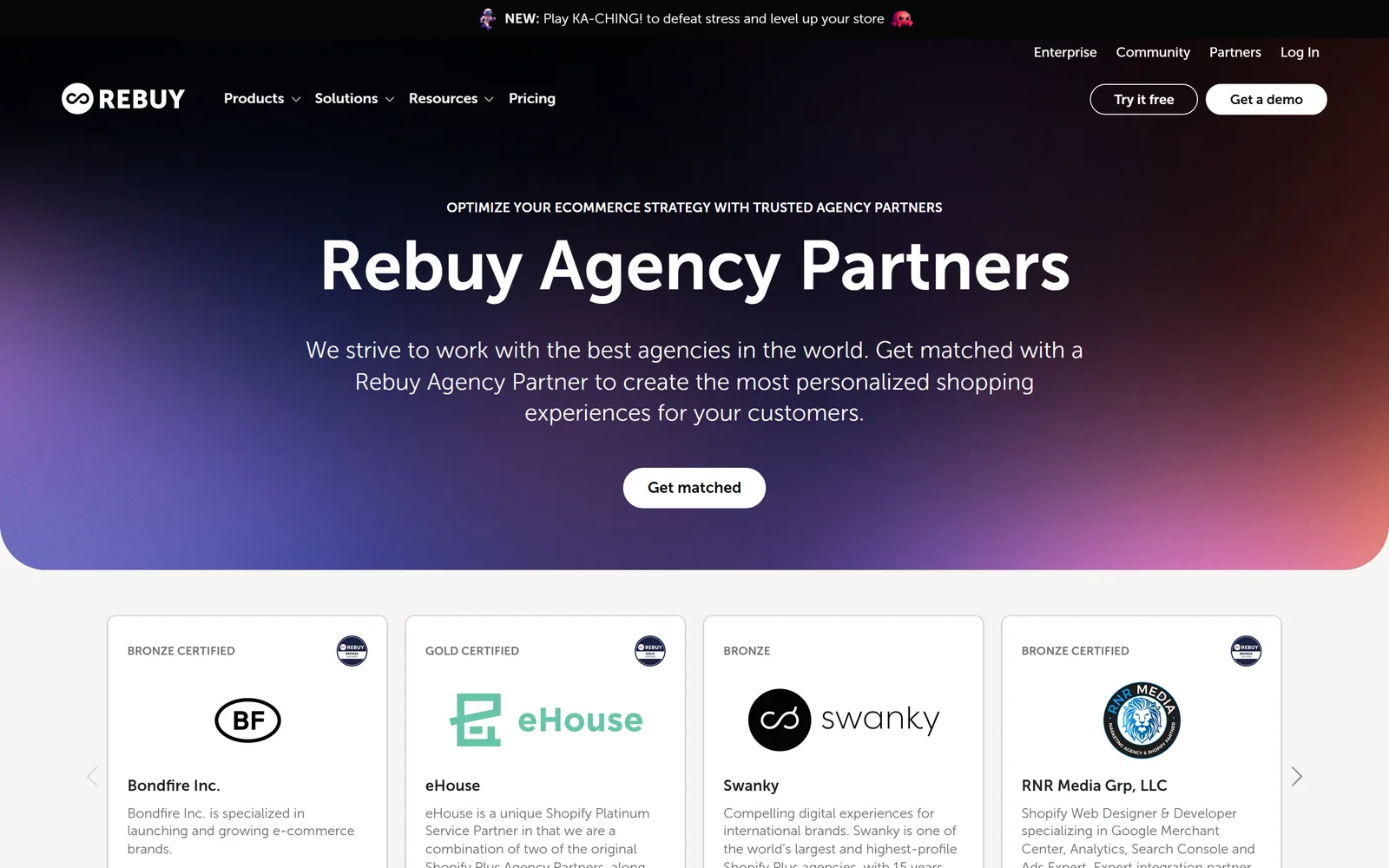
Merchants come here to find an implementation agency: 107 agency partners in a paginated card grid, filterable by Regions Serviced and Services Offered. Every card carries one of four tier badges (Gold, Silver, Bronze Certified, or Affiliate), so trust signals do the sorting before filters get touched.
Best of all is “Get matched,” a PartnerPage-hosted lead flow fronted by “Eric, your Agency Partner matchmaker” that routes browsers to a human.
Layout: Searchable directory · Lists: Agencies · Industry: E-commerce · Built with: PartnerPage · Visit the live page
38. Stripe Partner Directory
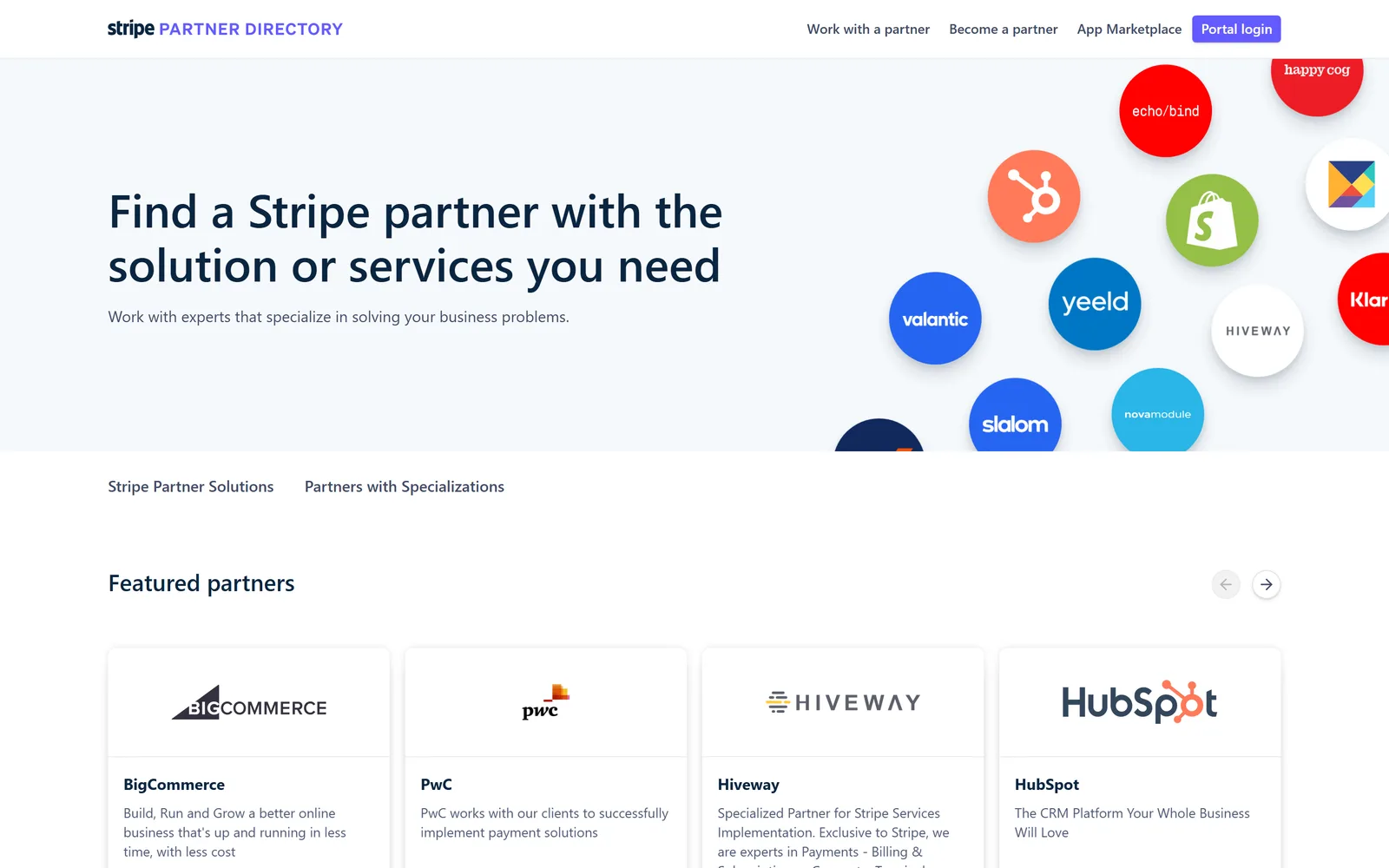
Stripe routes buyers to service help through a filterable card grid on its own domain, stripe.partners, faceted by “Help me with,” Category, Industry, and Locations, sorted by Recommended. It runs on PartnerPage rather than in-house infrastructure, with a 301 redirect from stripe.com/partners/directory.
“Specialized partner” badges on qualifying cards, plus dedicated detail pages, give agencies a credential worth earning.
Layout: Searchable directory · Lists: Tech partners, Agencies · Industry: Payments & fintech · Built with: PartnerPage · Visit the live page
39. Telnyx Partner Directory
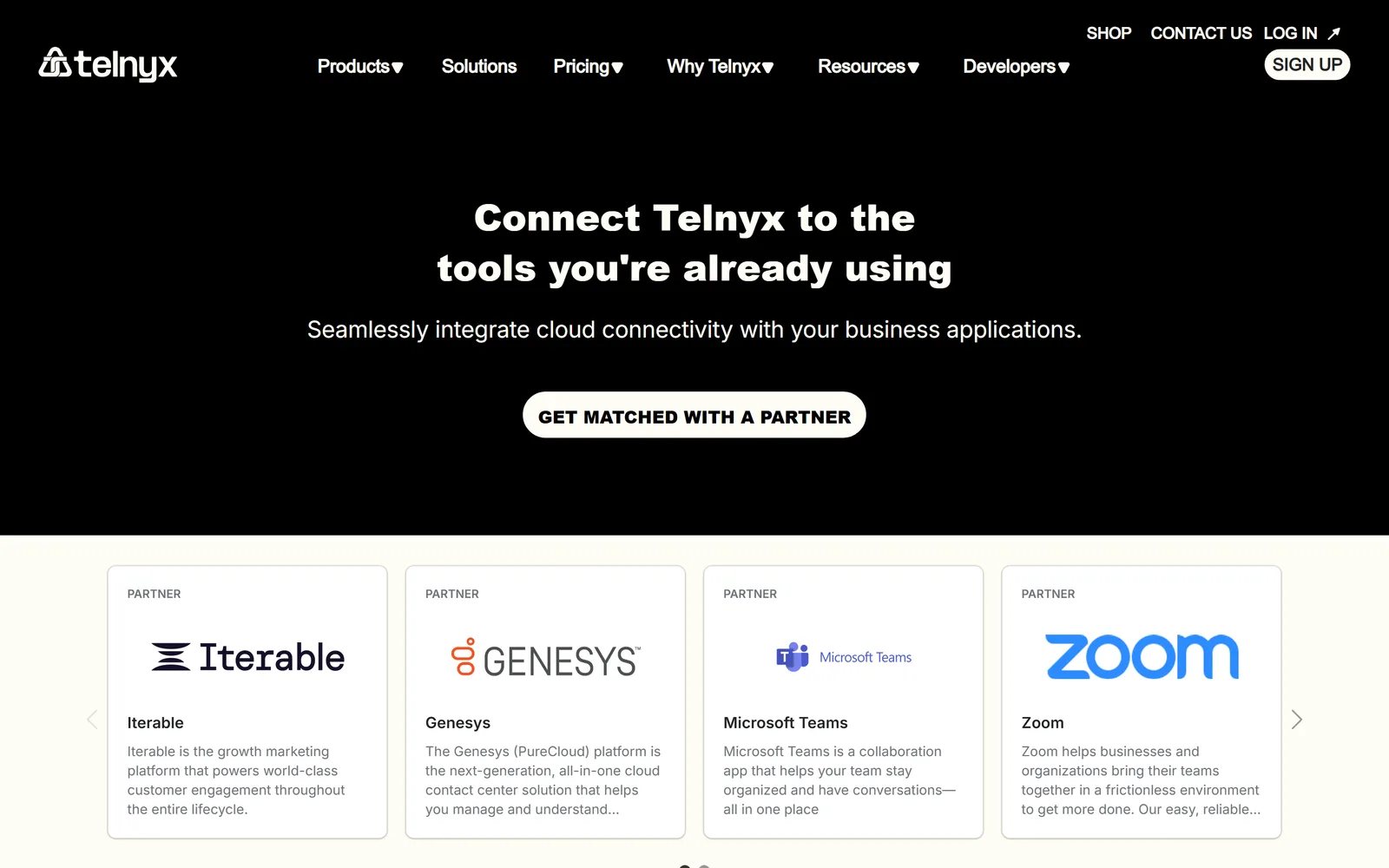
Six facets cover roughly 65 partners here: collections, categories, country, region, city, and a Name/Tier sort, with category tags encoding product, region, and use case in a single facet. Each card links to its own detail page on the same PartnerPage-hosted subdomain.
The concierge layer is the interesting part: a “Get matched with a partner” CTA turns the directory itself into a lead-capture channel.
Layout: Searchable directory · Lists: Tech partners, Agencies, Resellers · Industry: Communications · Built with: PartnerPage · Visit the live page
40. Thoropass Tech Partner Directory
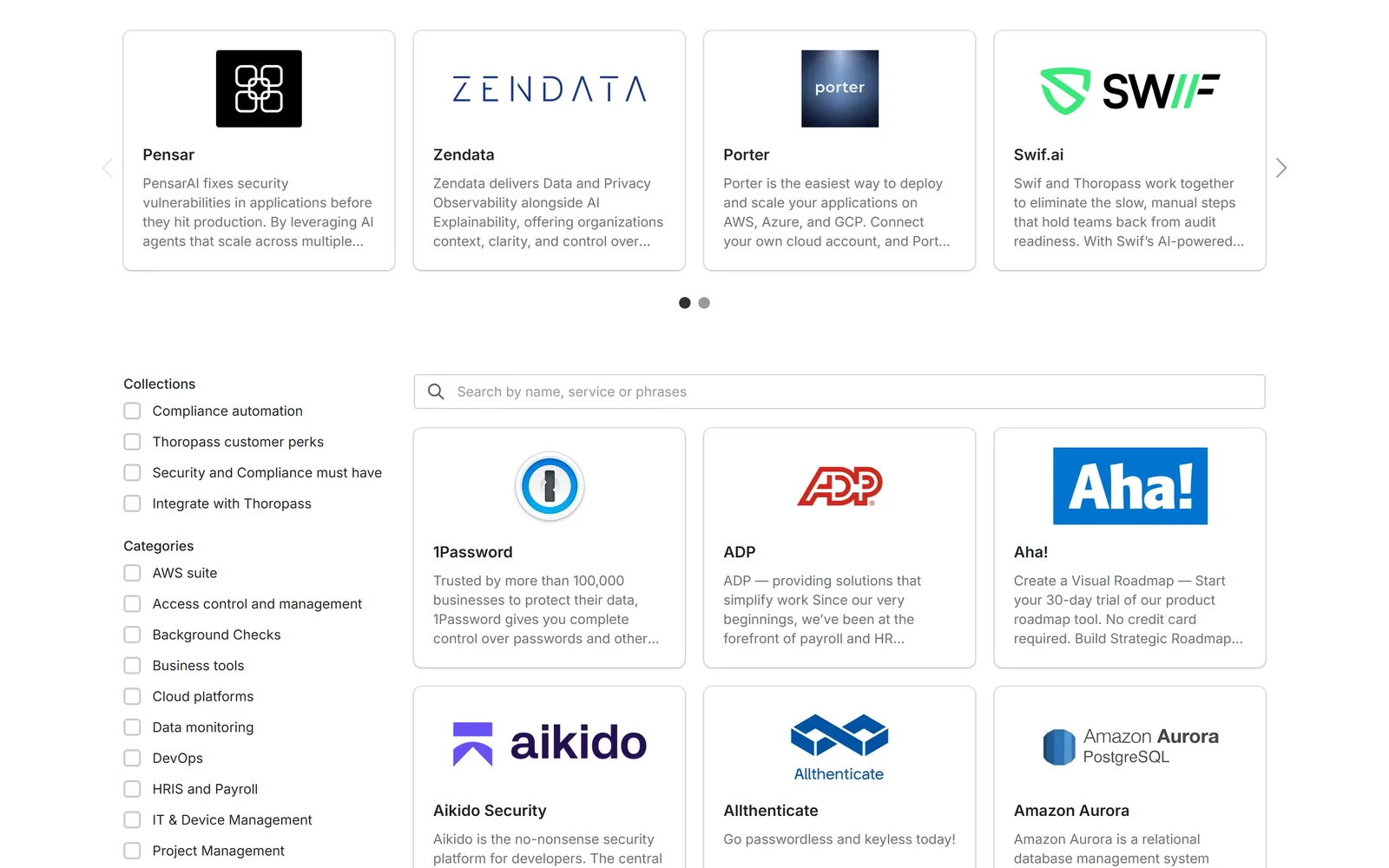
Thoropass splits its ecosystem into two directories: 204 tech partners searchable by functional category (access control, cloud platforms, DevOps), plus a separate “Find the right Thoropass Expert” list for service partners. A “Request an integration” CTA captures demand for tools not yet listed.
One caveat worth noting: it runs on PartnerPage at thoropass.partnerpage.io, and the main thoropass.com/partners page doesn’t clearly link to it.
Layout: Searchable directory · Lists: Tech partners, Agencies · Industry: Compliance & security · Built with: PartnerPage · Visit the live page
41. Twilio Partner Directory
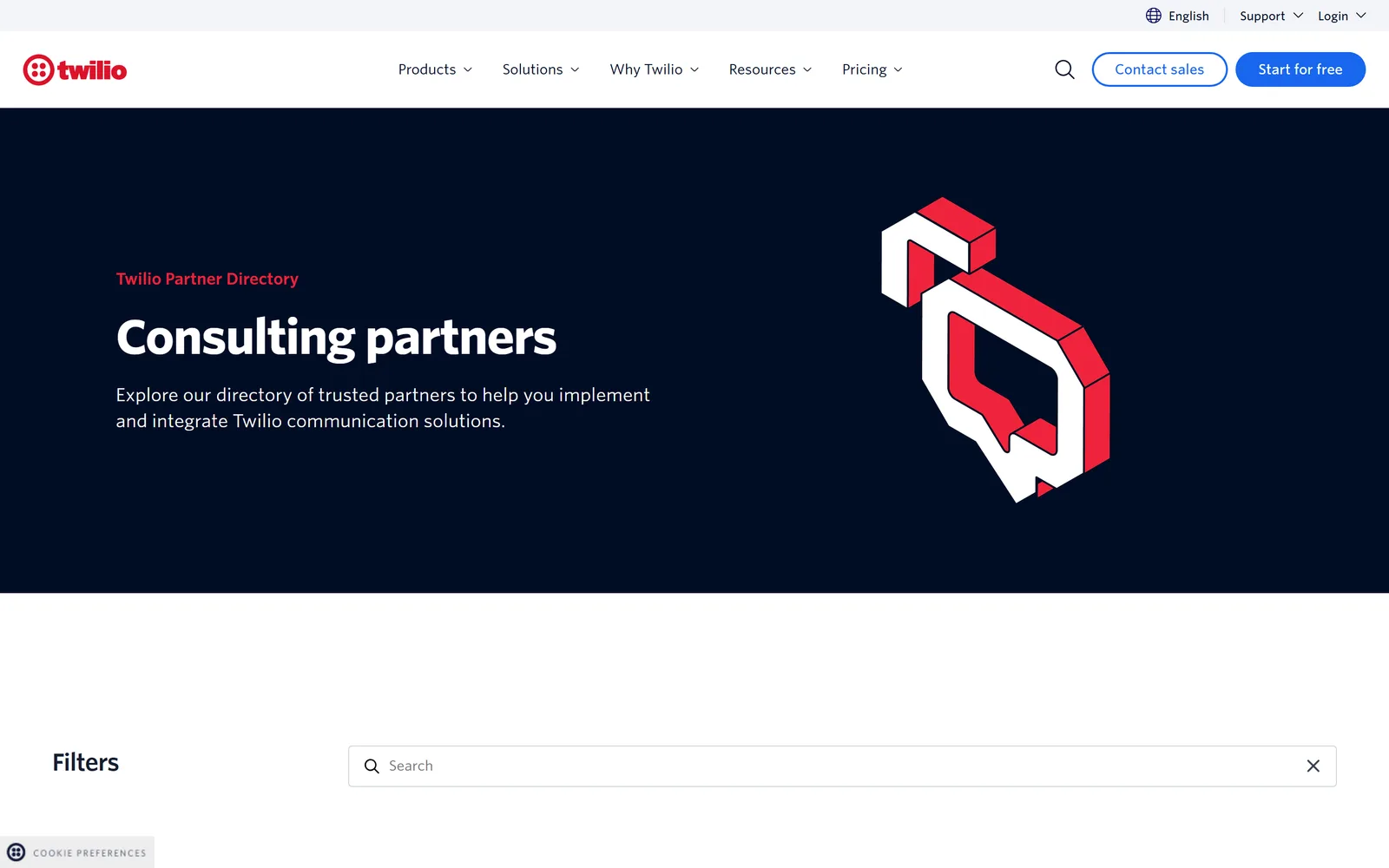
Twilio’s Partner Directory is a filterable listing of consulting, technology, and reseller partners, with facets for partner type and integrations. The surrounding partners hub splits the ecosystem into six category cards, including customer data technology partners with 700+ integrations.
Then there’s an unusual AEO play: the directory injects “summarize with ChatGPT/Gemini/Claude” buttons, pushing the page into AI answer engines.
Layout: Searchable directory · Lists: Tech partners, Agencies, Resellers · Industry: Communications · Built with: First-party · Visit the live page
42. Zapier Solution Partner Directory
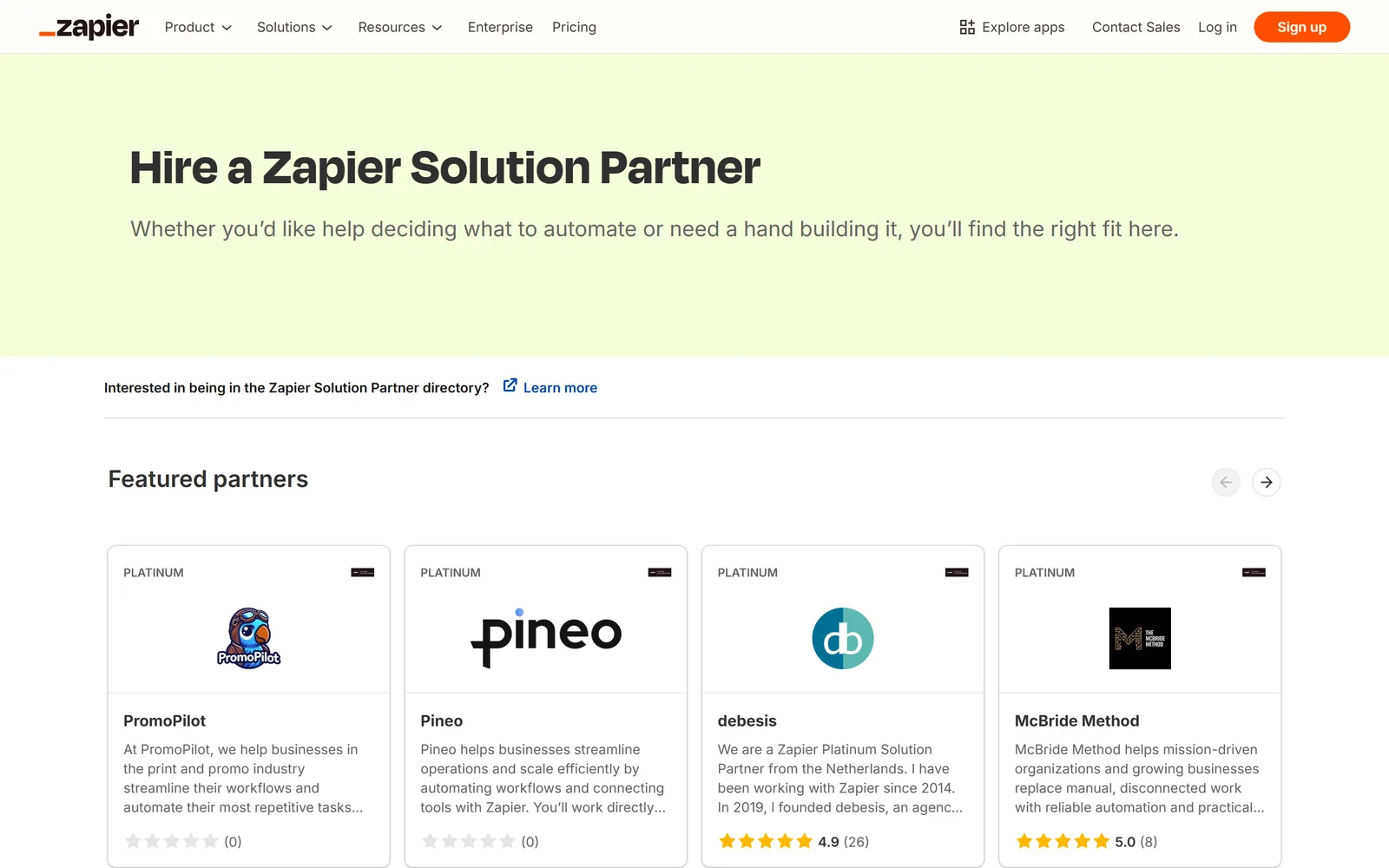
28+ Solution Partner agencies are sorted by tier and review count, with Platinum badges pinned to the top. Ten sidebar facets go unusually deep for buyers: Project Budget, Minimum Spend, even Free Discovery Call, alongside star ratings with real review counts.
A “Let us match you” concierge CTA turns browsing into captured leads, and the whole thing runs on PartnerPage.
Layout: Searchable directory · Lists: Agencies · Industry: Developer tools & APIs · Built with: PartnerPage · Visit the live page
What the best partners pages have in common
Across all 42 pages, the strong ones converge on the same handful of decisions:
- Every partner gets its own URL. A real page that can rank for the partner’s own name, not a modal or a popup.
- Filters match how buyers actually think. Partner type, category, region and budget beat one long alphabetical list.
- Trust signals sit on the card, before the click. Tier badges, star ratings, review counts, install counts, verification marks.
- Search arrives when the catalog outgrows browsing. Below roughly fifty listings, well-chosen filters do the job on their own.
- There is an obvious path to becoming a partner. The directory recruits supply as well as serving demand.
- The best ones capture leads. A “get matched” or concierge flow turns a browsing visitor into a routed enquiry.
Partners page FAQ
What is a partners page?
A partners page (or partner directory) is a page on a company’s website that lists the agencies, technology partners, resellers, or app integrations that work with its product. The strongest ones are browsable directories with search and filters rather than static logo lists.
What should a partners page include?
The pages in this roundup converge on the same ingredients: a search box once the catalog is large enough to need one, filters that match how buyers think (partner type, category, region), a short description per partner, individual partner pages with their own URLs, and a visible “become a partner” call to action for recruitment.
What is the difference between a partners page and an integrations page?
A partners page lists companies, such as agencies, consultancies and resellers, while an integrations page lists product-to-product connections. Many SaaS companies merge both into one directory with a partner-type filter, which is the pattern most examples here follow.
How do I build a partners page on WordPress?
You need a directory rather than a hand-maintained list: each partner as its own entry with a logo, description and URL, with filters and search over the top. Integrations Directory is a WordPress plugin that does exactly that on your own domain, with CSV import for bulk entries and a page for every listing. There is a 30-day free trial.
Build a partners page like these
Integrations Directory turns any WordPress site into a searchable partner directory: filters, individual partner pages, tier badges and CSV import, on your own domain rather than a subdomain. It is the pattern behind most of the pages above, without the enterprise price tag.